

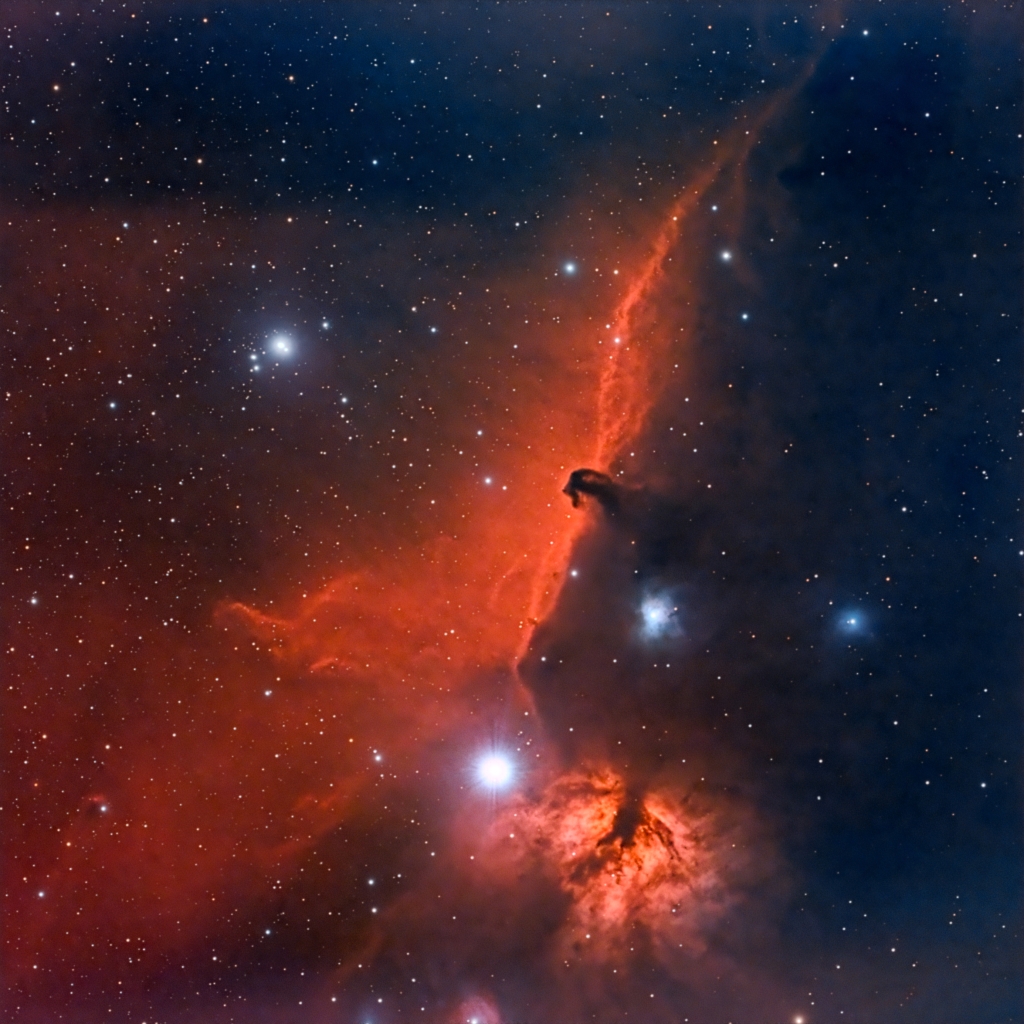
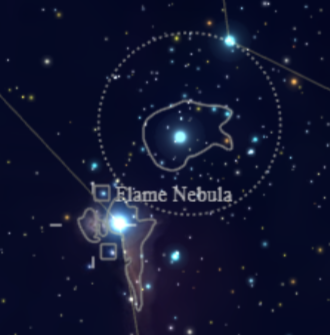
The Flame and Horsehead Nebulas
Located in the constellation Orion approximately 1,300–1,500 light-years from Earth, the Flame Nebula (NGC 2024) and the Horsehead Nebula (Barnard 33) lie along the eastern edge of Orion’s Belt near the brilliant star Alnitak. Though visually close in the sky, they represent very different types of nebulae. The Flame Nebula is a glowing emission nebula energized by intense ultraviolet radiation from nearby massive stars, while the Horsehead is a dark nebula — a dense cloud of cold dust silhouetted against the bright hydrogen emission of IC 434 behind it. Together, they form one of the most iconic deep-sky regions in winter skies.
The Flame Nebula is an active stellar nursery composed primarily of ionized hydrogen gas threaded with dark dust lanes. At its core lies a young embedded star cluster, largely hidden in visible light but revealed in infrared observations. The ultraviolet radiation from these hot, newly formed stars excites the surrounding gas, causing it to glow in deep reds characteristic of hydrogen-alpha emission. The complex network of dust lanes seen cutting through the nebula absorbs and scatters light, producing the “flame-like” structure that gives NGC 2024 its name.
Just to the south, the Horsehead Nebula stands as one of the sky’s most recognizable silhouettes. The dark column of molecular gas and dust spans roughly 3–4 light-years and is part of a much larger cloud complex within Orion’s molecular cloud system. The reddish backdrop against which it appears is the emission glow of IC 434, ionized by nearby massive stars. Within the dense cloud of the Horsehead, new stars are forming, though hidden from view by thick dust. This region offers a striking contrast between creation and concealment — brilliant radiation illuminating glowing gas on one side, and cold, star-forming darkness on the other — a powerful reminder of the dynamic processes shaping stellar birth in our galaxy.
Sources
- NASA/IPAC Extragalactic Database (NED)
- SIMBAD Astronomical Database
- Hubble Space Telescope Image Archive
- ESA/Hubble Orion Nebula studies
Project Details
-
Belleville, MI - 02/11/26
-
ZWO FF65 telescope FL = 416mm, f6.4, ASI294MCPro, Antlia Triband Filter, 40 second subs, iso4000, 2h40m integration time