

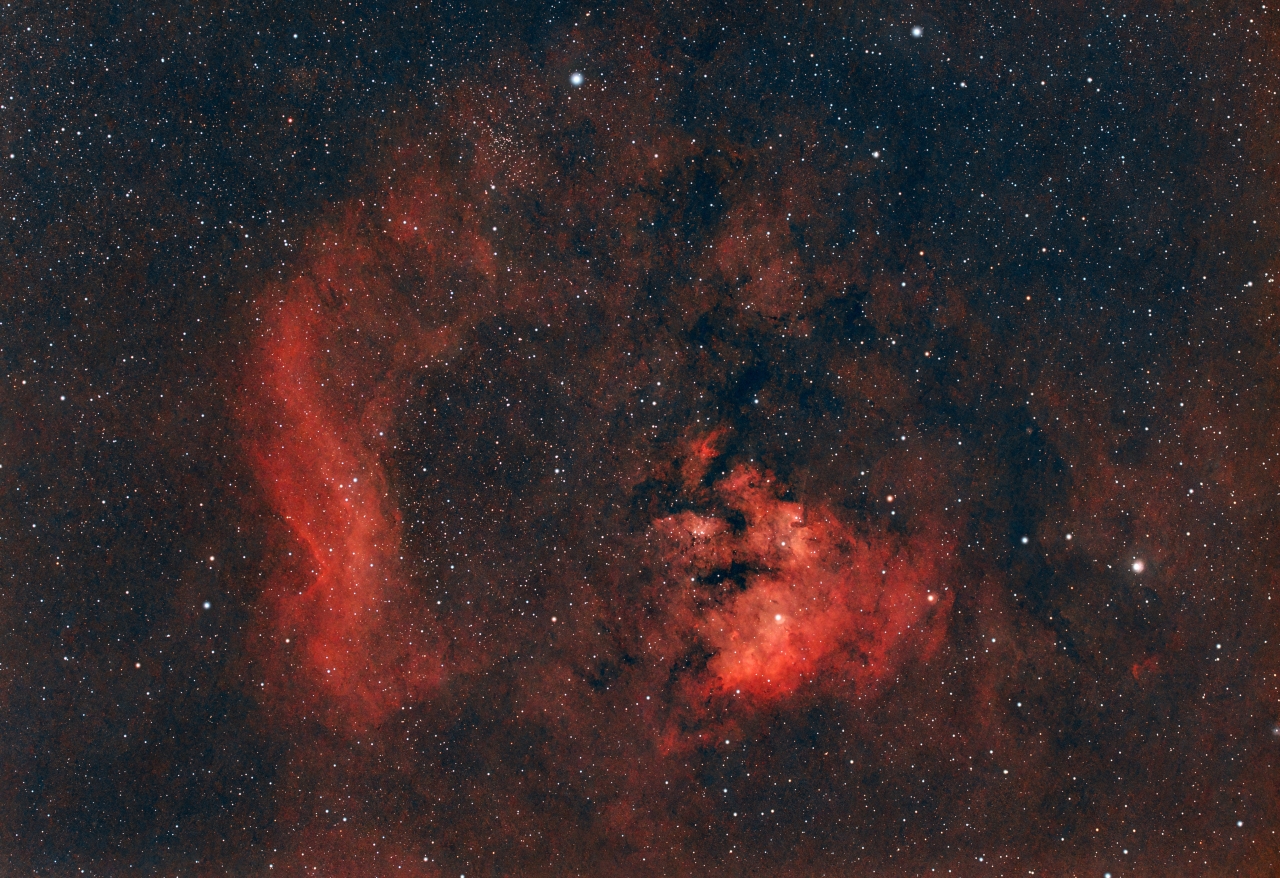
NGC 7822 – CED 214 Nebulae in Cassiopeia
July 2025
NGC 7822 and Cederblad 214 (Ced 214) are two closely related designations within the same vast star-forming complex in Cepheus, often photographed as the “Cosmic Question Mark.” In the scientific literature the wider region is commonly discussed as Sharpless 2-171 (Sh2-171), with additional identifiers such as LBN 589 used for portions of the nebulosity. Distance estimates place the complex at roughly 800–1000 pc (≈2,600–3,300 light-years), and on the sky it spans on the order of ~1.5–3 degrees, corresponding to a physical size of roughly ~150 light-years for the brightest structured region. In many wide-field images, NGC 7822 refers to the fainter northern arc while Ced 214 labels the brighter, more intricate emission region to the south—both illuminated faces of the same giant molecular environment.
Astrophysically, this is a classic H II region / molecular cloud interface dominated by Hα emission with contributions from other nebular lines, threaded with dark dust lanes and pillar-like “elephant trunk” structures where dense gas resists erosion. The primary excitation comes from the embedded young cluster Berkeley 59, which contains dozens of hot early-type stars and includes one of the most extreme systems in the nearby kpc: BD+66 1673 (V747 Cep), an eclipsing binary with an O5 V component quoted near ~45,000 K and ~100,000 L☉. Cluster studies find very young ages (a few Myr); for example, detailed photometry work reports massive-star ages around ~2 Myr and a cluster distance near ~1.00 ± 0.05 kpc, consistent with ongoing/very recent star formation. The region’s pillars have even been analyzed for internal dynamics (including “rotating elephant trunks”), making NGC 7822/Ced 214 a useful case study in how UV radiation and winds from O/B stars sculpt and potentially trigger star formation along cloud edges.
Historically, NGC 7822 was recorded by John Herschel on 16 November 1829, who noted an extremely faint portion of a much larger nebula—an observation later incorporated by Dreyer into the New General Catalogue as NGC 7822. The label Cederblad 214 comes from Swedish astronomer Sven Cederblad’s 1946 catalog of bright diffuse Galactic nebulae, which organized and clarified many Milky Way nebula identifications (and is why “Ced 214” persists as a precise tag for the bright southern emission patch within Sh2-171). Together, the multiple names reflect how large emission complexes were historically “split” into sub-features as observations improved—while modern astrophysics treats the field as a unified, feedback-shaped star-forming environment anchored by Berkeley 59 and its massive stars.
Sources & References
- SEDS NGC Database — NGC 7822 entry (catalog identifiers, basic object description)
https://spider.seds.org/ngc/ngc.cgi?ngc7822= - Constellation Guide — NGC 7822 discovery (John Herschel, 16 Nov 1829)
https://www.constellation-guide.com/question-mark-nebula-ngc-7822/ - DeepSkyCorner — NGC 7822 / Cederblad 214 overview; Ced 214 attribution to Cederblad (1946) and naming notes
https://www.deepskycorner.ch/obj/ngc7822.en.php - ADS (Harvard) / VizieR Catalog record — Cederblad catalog (bright diffuse Galactic nebulae; 1946)
https://ui.adsabs.harvard.edu/abs/2001yCat.7231….0C/abstract
https://vizier.cds.unistra.fr/viz-bin/VizieR?-source=VII/231 - Pandey et al. (2008), MNRAS — Berkeley 59 stellar content, distance, and very young ages
https://academic.oup.com/mnras/article/383/3/1241/1038513
https://ui.adsabs.harvard.edu/abs/2008MNRAS.383.1241P/abstract - Gahm et al., “Rotating elephant trunks” (A&A; thesis copy/record) — pillar dynamics including a trunk in NGC 7822
https://www.diva-portal.org/smash/record.jsf?pid=diva2:454721
Project Details
-
Belleville, MI
-
ZWO FF65, FL = 312mm, f4.8, Pentax K3ii, Antlia Triband Filter, 18h7m Total Integration Time