

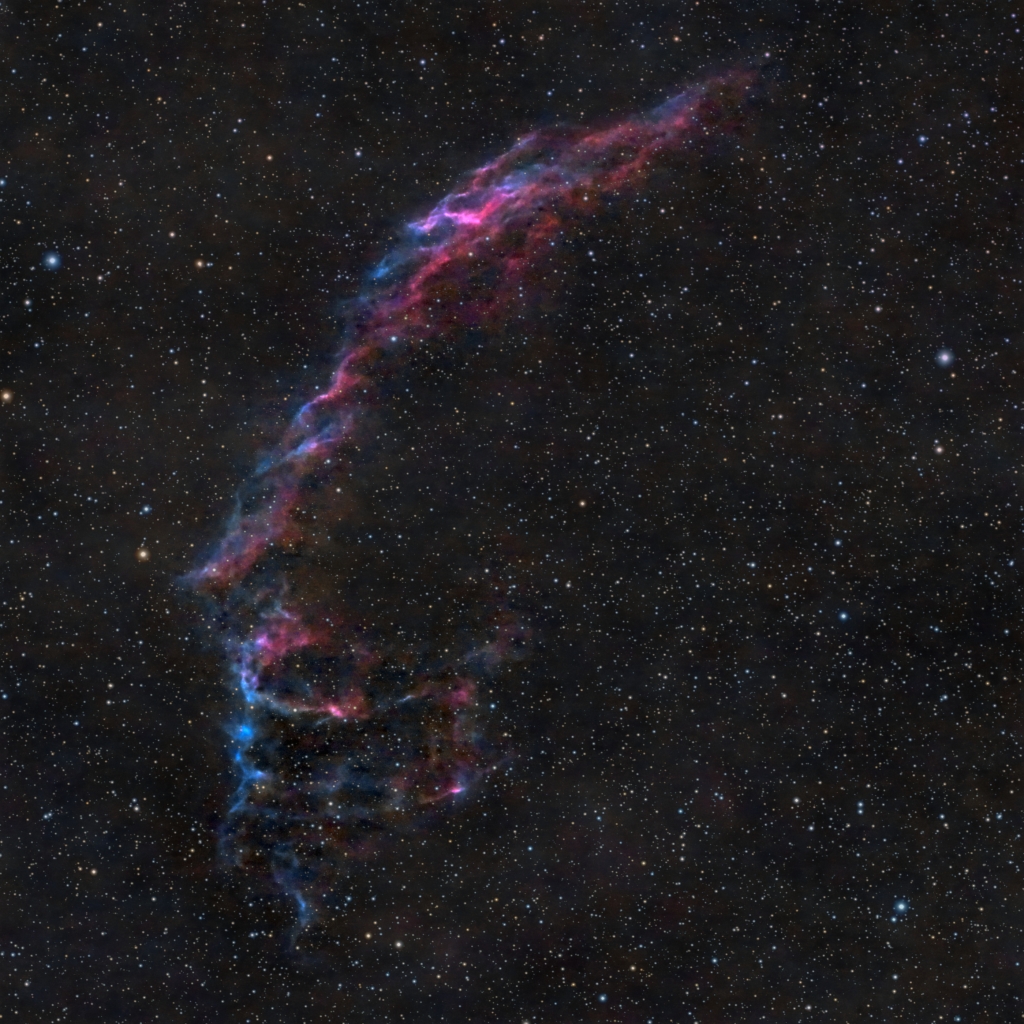
The Eastern Veil Nebula – NGC 6995 – NGC 6992
7/31-8/1 2025
NGC 6992 and NGC 6995 are the two brightest cataloged arcs of the Eastern Veil Nebula, part of the larger Cygnus Loop supernova remnant (G74.0−8.5) in the constellation Cygnus. On the sky, this remnant spans roughly ~3° (several full-moon diameters), and modern distance work places it at about 2,400–2,600 light-years. The Cygnus Loop is the expanding debris from a massive-star explosion that occurred roughly ~17,000–25,000 years ago, so the filaments we see in NGC 6992/6995 are relatively nearby examples of how a supernova shock sculpts and lights up the interstellar medium.
Physically, the “lacework” appearance comes from thin sheets of gas viewed edge-on, where the supernova blast wave is compressing, heating, and ionizing the surrounding material. In imaging (and in spectra), the eastern filaments are strongly dominated by classic shock/nebular lines—Hα from hydrogen, [O III] from doubly ionized oxygen, and [S II] from sulfur—making this region especially responsive to narrowband filters. Those line ratios and filament morphologies are not just pretty: they encode the shock conditions and the density structure of the local interstellar medium, and have been used for decades as a reference case for interpreting radiative vs. non-radiative shocks in supernova remnants.
Historically, the Veil’s bright arcs were first detected visually by William Herschel on 5 September 1784, but because the object is so large, its brightest sections were long treated as separate nebulae. The specific NGC entries NGC 6992 and NGC 6995 reflect this fragmentation: John Herschel later separated and assigned the two identifiers (observed in 1825) to the northern and southern portions of the eastern arc. In modern astrophysics the Cygnus Loop is also a “time-lapse” target—Hubble imaging separated by years has directly shown measurable filament expansion, helping connect observed proper motions to physical shock speeds and to the remnant’s distance and evolutionary state.
Sources & References
- SEDS (Students for the Exploration and Development of Space) — Veil Nebula overview; discovery note; NGC 6992/6995 identification
https://spider.seds.org/spider/Misc/veil.html - McDonald Observatory (2024-07-19) — Updated distance range and age estimate for the Cygnus Loop
https://mcdonaldobservatory.org/news/releases/20240719 - NASA Hubble Caldwell Catalog — Caldwell 33 (Eastern Veil = NGC 6992/6995); scale and context
https://science.nasa.gov/mission/hubble/science/explore-the-night-sky/hubble-caldwell-catalog/caldwell-33/ - ESA/Hubble (2015-09-24) — “Revisiting the Veil Nebula”; expansion visible via multi-epoch HST imaging
https://esahubble.org/news/heic1520/ - NOIRLab image release — NGC 6992; distance and “Cygnus Loop” identification (public-outreach summary)
https://noirlab.edu/public/images/noao-ngc6992/
Project Details
-
Belleville, MI
-
ZWO FF65-FL=312mm, Pentax K3ii, Broadband, 4 min subs, 5h20m Integration Time