

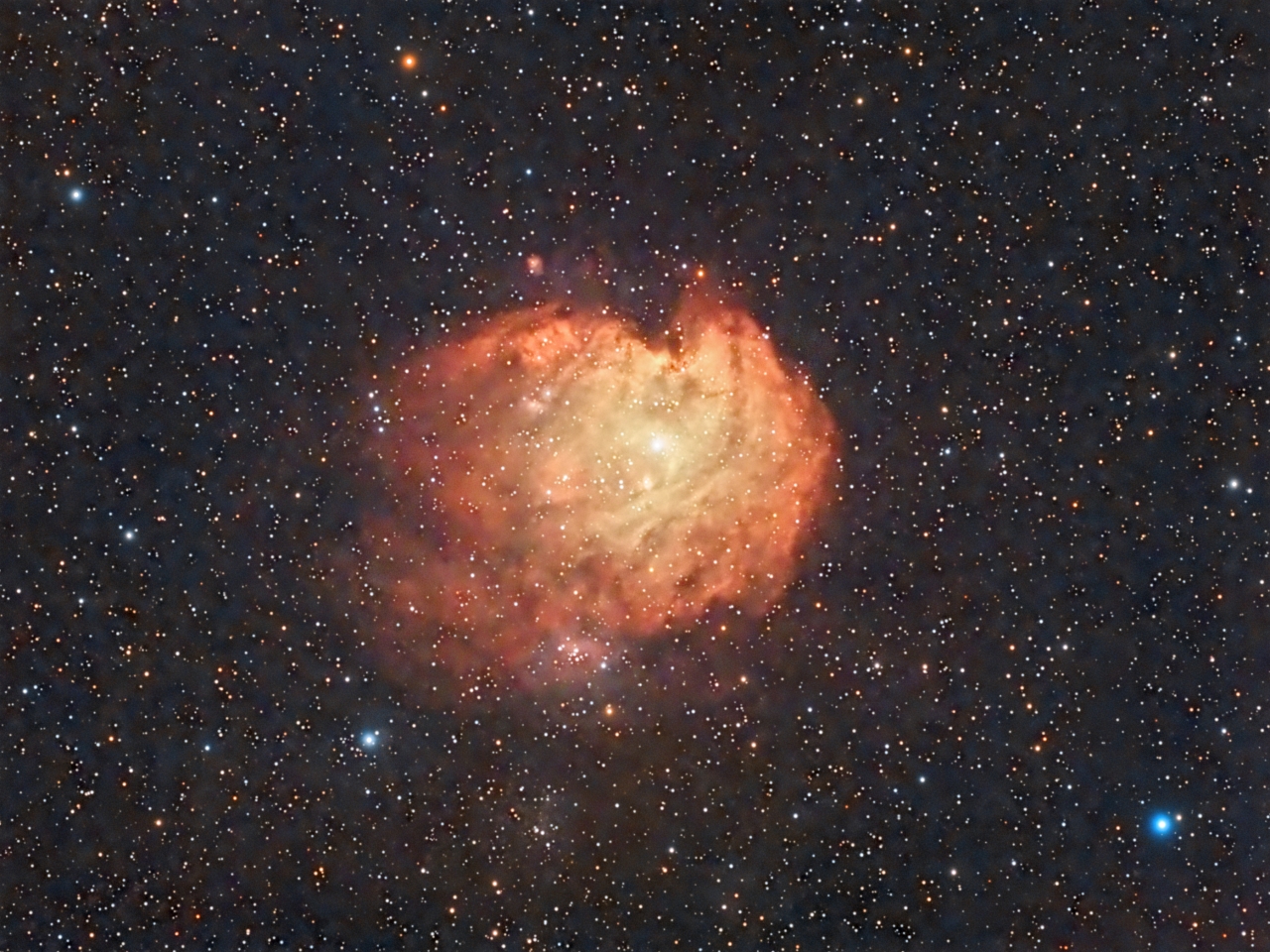
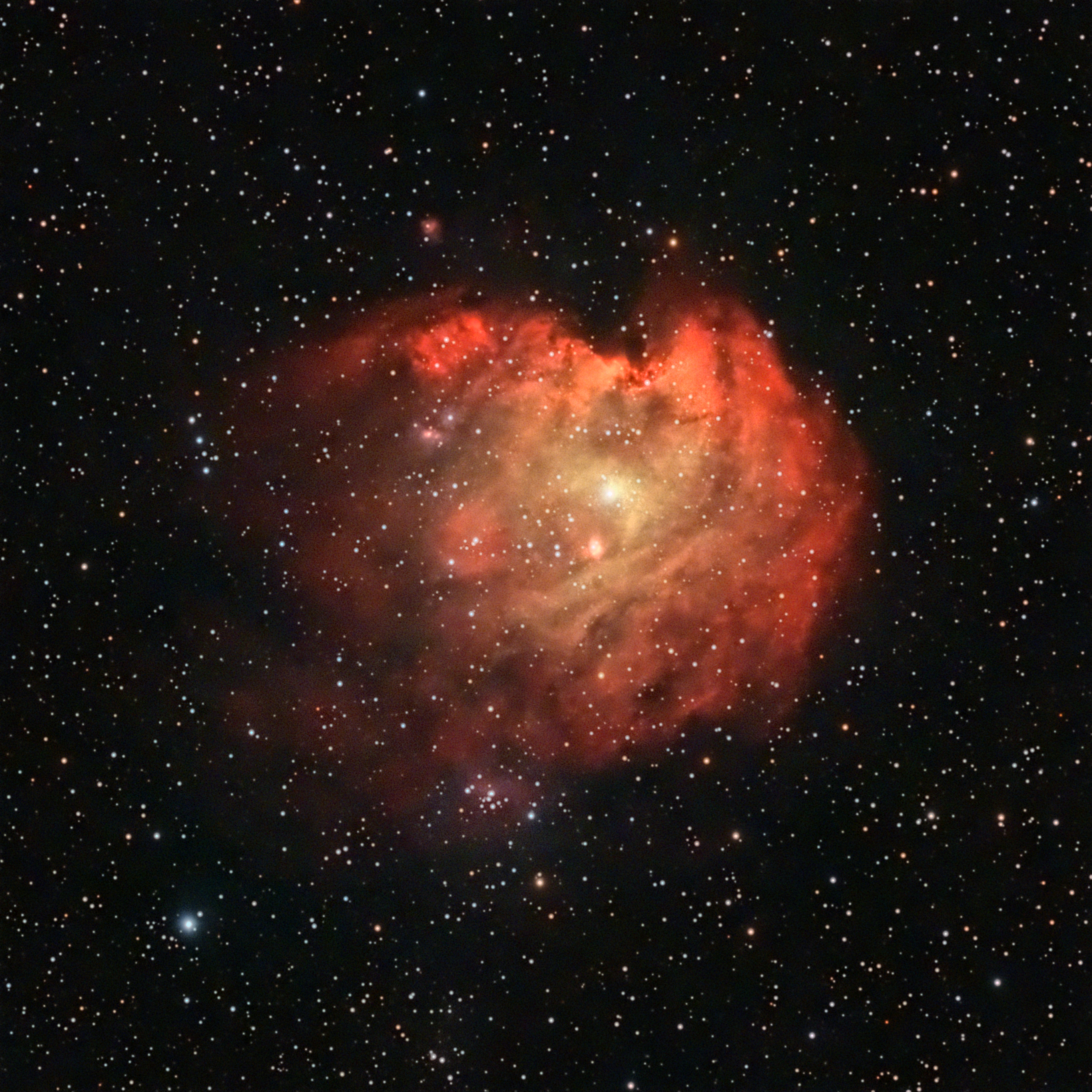
NGC 2174, The Monkey Head Nebula
01/2026
NGC 2174, popularly known as the Monkey Head Nebula, is an expansive emission nebula located in the constellation Orion, near the border with Gemini and not far from the bright star Betelgeuse. The nebula lies at a distance of roughly 6,400–6,500 light-years from Earth and spans more than 50 light-years across. Its nickname comes from the characteristic profile formed by dark dust lanes cutting into the glowing gas, which in deep images resembles the face of a monkey looking off to the side.
The nebula is composed primarily of ionized hydrogen gas, glowing strongly in H-alpha, with additional emission from sulfur and oxygen highlighting shock fronts and ionization boundaries. The region is energized by hot, young O- and B-type stars, whose ultraviolet radiation strips electrons from hydrogen atoms and causes the surrounding gas to shine. Dense pockets of dust embedded within the nebula block the background light, creating the sculpted shapes and high-contrast features that define the Monkey Head’s appearance.
Closely associated with NGC 2174 are several young star clusters, most notably NGC 2175, a loose open cluster historically thought to be the nebula’s central cluster. Modern studies suggest NGC 2175 is a somewhat dispersed grouping of young stars embedded within the larger star-forming complex rather than a tightly bound cluster. Together, the nebula and its neighboring stellar groups represent an active stellar nursery, where radiation and winds from newly formed stars both erode the surrounding cloud and help trigger additional star formation. As part of the broader Orion region, NGC 2174 offers astronomers a valuable window into how massive stars shape their birth environments and influence the next generation of stars.
Sources & References
- Wikipedia — “NGC 2174” and “Monkey Head Nebula” (location, distance, nebular classification)
- Wikipedia — “NGC 2175” (cluster description and relationship to NGC 2174)
- SEDS (Students for the Exploration and Development of Space) — NGC 2174 and NGC 2175 deep-sky object notes
- NASA / ESA — Star formation studies in the Orion region
- Astrophysical Journal — Research on embedded clusters and star formation in NGC 2174
Project Details
-
Belleville, MI
-
ZWO ff65 at f6.4, FL=416mm, ZWO ASI294MC Pro, 4 min subs, Antlia Triband filter, 3h48m integration time