

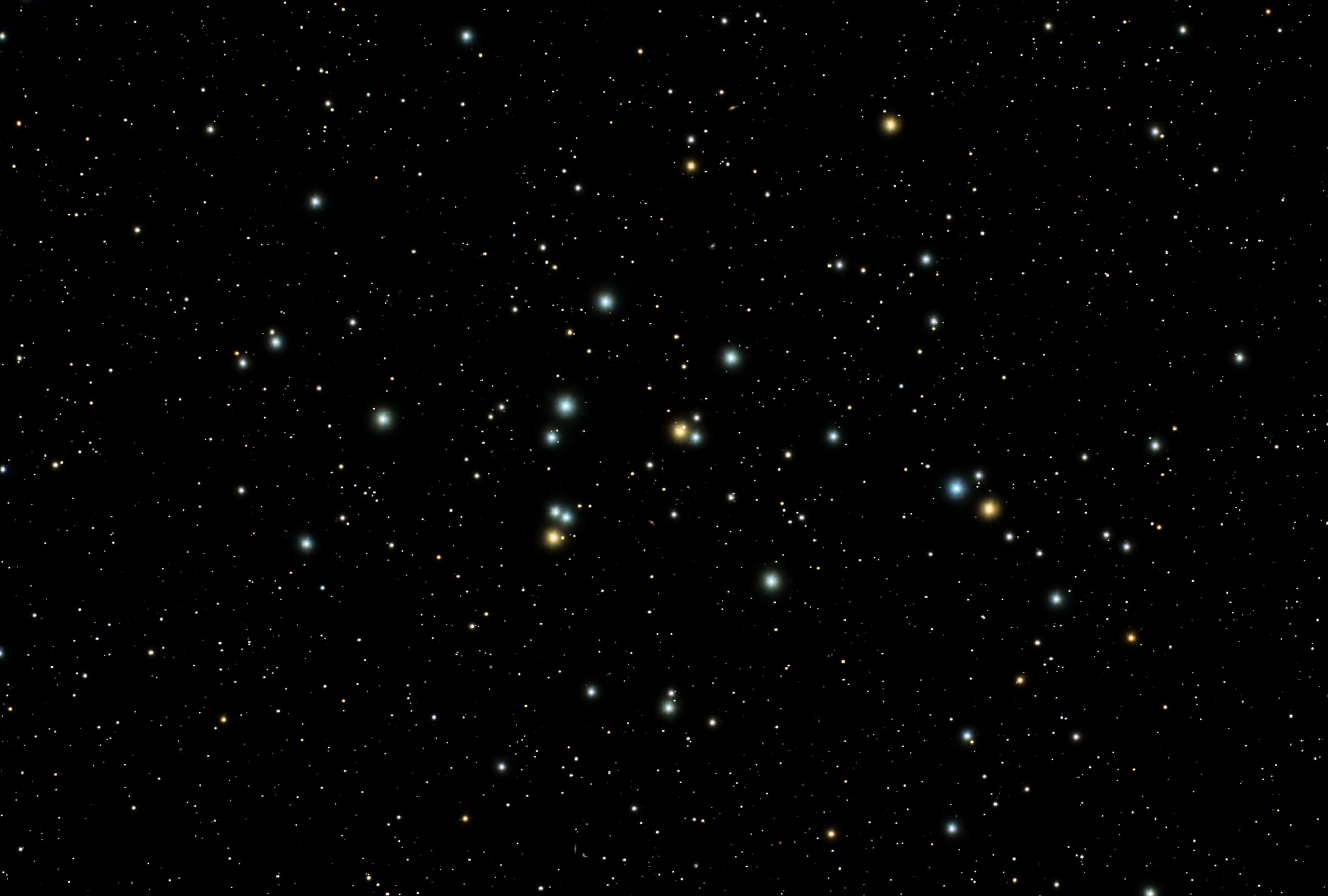
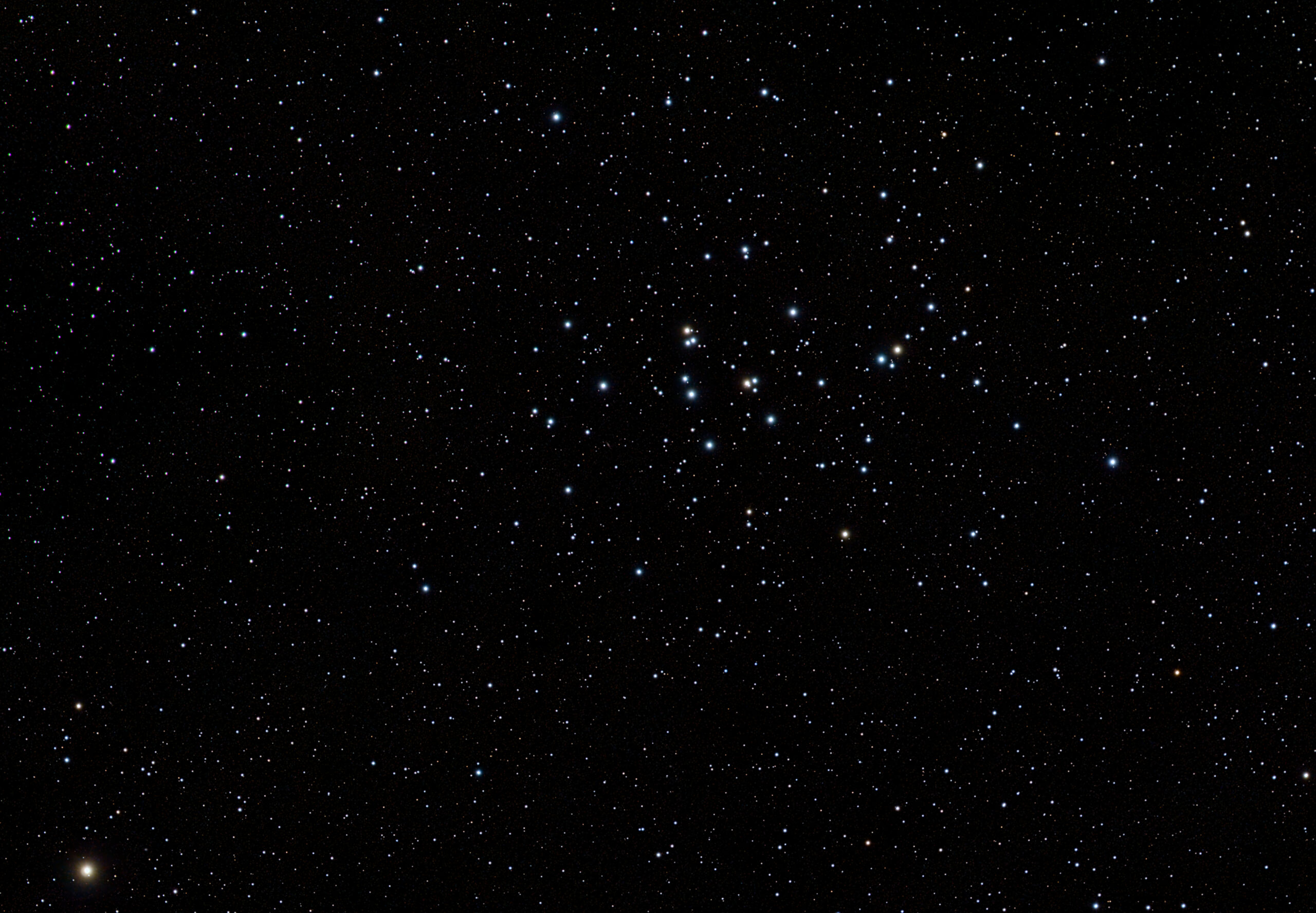
Messier 44; The Beehive Cluster
Messier 44, commonly known as the Beehive Cluster or Praesepe, is a bright open star cluster located in the constellation Cancer. Under dark skies, it is visible to the unaided eye as a soft, misty patch of light between Gemini and Leo. Binoculars transform that haze into a sparkling swarm of stars, giving the cluster its familiar “beehive” appearance.
M44 lies about 600 light-years from Earth and contains hundreds of stars born from the same ancient cloud of gas and dust. At roughly 600–700 million years old, it is much older than young clusters such as the Pleiades, yet still close enough and bright enough to be one of the finest open clusters for visual observing and wide-field astrophotography. Its stars are spread across a broad area of sky, making it especially beautiful in binoculars or short-focal-length telescopes.
The Beehive Cluster has been known since antiquity and was observed long before the invention of the telescope. To ancient observers, its faint glow was sometimes used as a weather sign: when the cluster disappeared from view in an otherwise clear sky, haze or approaching clouds were suspected. Today, M44 remains a favorite spring target, offering a quiet, graceful contrast to the dramatic nebulae and galaxies nearby.
Sources
- SIMBAD Astronomical Database – Messier 44
- NASA/IPAC Infrared Science Archive – Praesepe Cluster
- WEBDA Open Cluster Database – M44 / Praesepe
- Messier, Charles. Catalogue des Nébuleuses et des Amas d’Étoiles
Project Details
-
Belleville, MI Bortle 6+
-
ZWO FF107, FF65, ASI294MC Pro, Broadband, 4 min subframes