
In and around the constellation of orion
In the majestic winter night sky, Orion stands as a beacon of celestial wonder, his belt of three bright stars—Alnitak, Alnilam, and Mintaka—serving as a guide to treasures scattered across the heavens. Surrounding this mighty constellation, and stretching into neighboring Auriga and Taurus, are vast regions of glowing nebulae, star clusters, and dark molecular clouds. Together they form one of the richest and most photogenic corridors of the Milky Way.
Nestled below Orion’s Belt, the Orion Nebula (M42) glows in vibrant hues of magenta and violet. This stellar nursery is a swirling cloud of gas and dust illuminated by the intense radiation of young, hot stars at its heart. With radiant tendrils and intricate textures, M42 captivates stargazers and astrophotographers alike, offering a glimpse into the very process of star birth.
Just east of Alnitak, the iconic Horsehead Nebula emerges—a dark, silhouetted shape resembling a rearing horse, set against the crimson glow of hydrogen gas. Nearby, the Flame Nebula flickers like an otherworldly bonfire, its fiery plumes intertwined with dark lanes of dust. These dramatic contrasts of light and shadow define the eastern edge of Orion’s great molecular cloud complex.
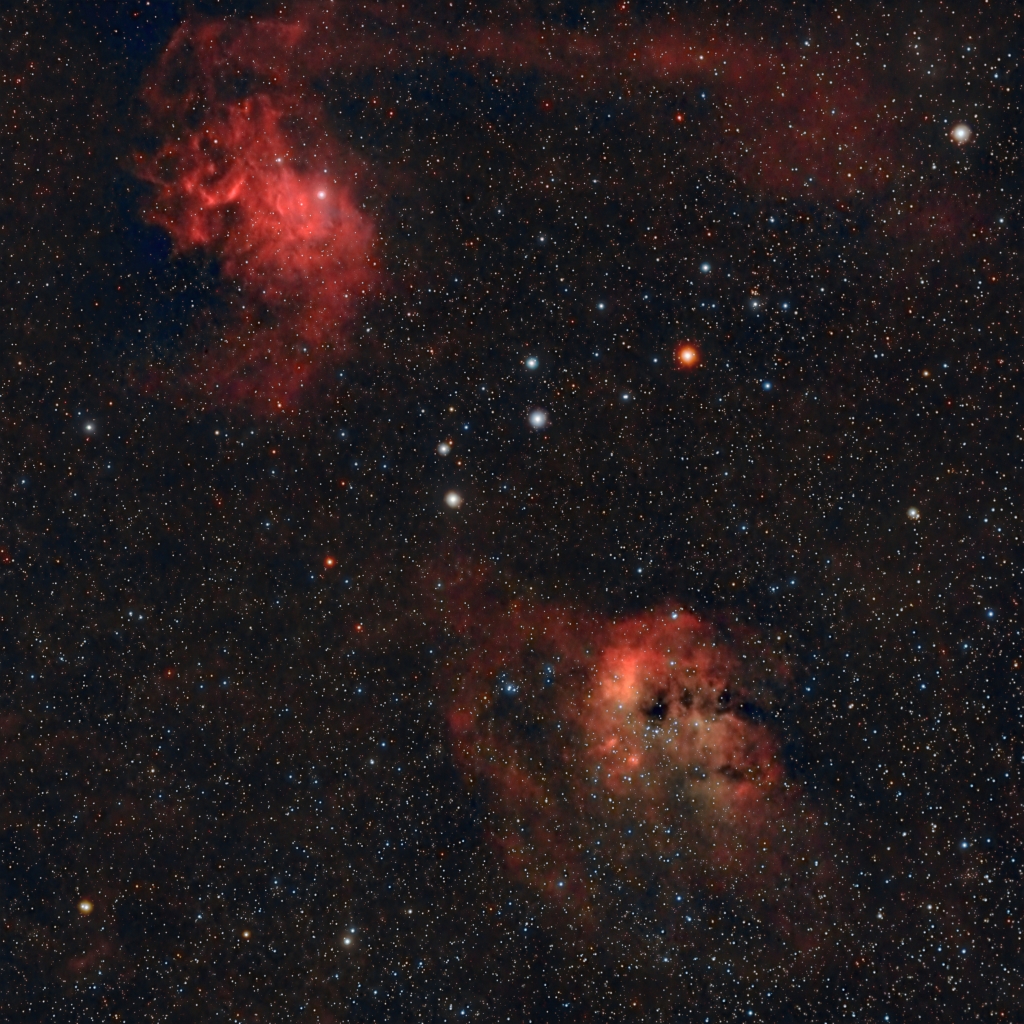
Moving northward into Auriga, the sky reveals a different character—one shaped by glowing hydrogen clouds and embedded star clusters. The open cluster M35 sparkles along the border with Gemini, a rich gathering of young stars that contrasts beautifully with the surrounding winter Milky Way. Within Auriga itself, broad emission regions such as IC 405 (the Flaming Star Nebula) and IC 410 (the Tadpoles Nebula) glow with delicate reds and subtle blues, energized by hot, luminous stars embedded within them. Nearby, IC 417 and the Spider and Fly Nebula add intricate structures of gas and dust, forming vast stellar nurseries hidden within the constellation’s boundaries.
In Taurus, the Hyades cluster forms the face of the Bull, while the delicate Pleiades shimmer in icy blue, their stars wrapped in reflective dust. Farther along lies the glowing expanse of the Crab Nebula, the remnant of a long-ago stellar explosion that once blazed in Earth’s daylight sky.
Together, Orion, Auriga, and Taurus create a sweeping winter panorama—a tapestry of birth, life, and death among the stars. From luminous emission nebulae to ancient supernova remnants and glittering clusters, this region invites observers to linger, explore, and contemplate the grandeur woven into our corner of the galaxy.
sky maps
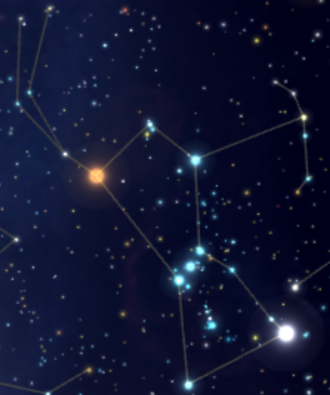
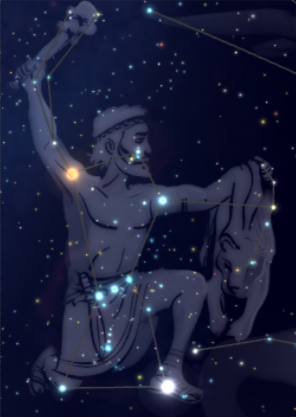

click any image to for details on the object or to comment
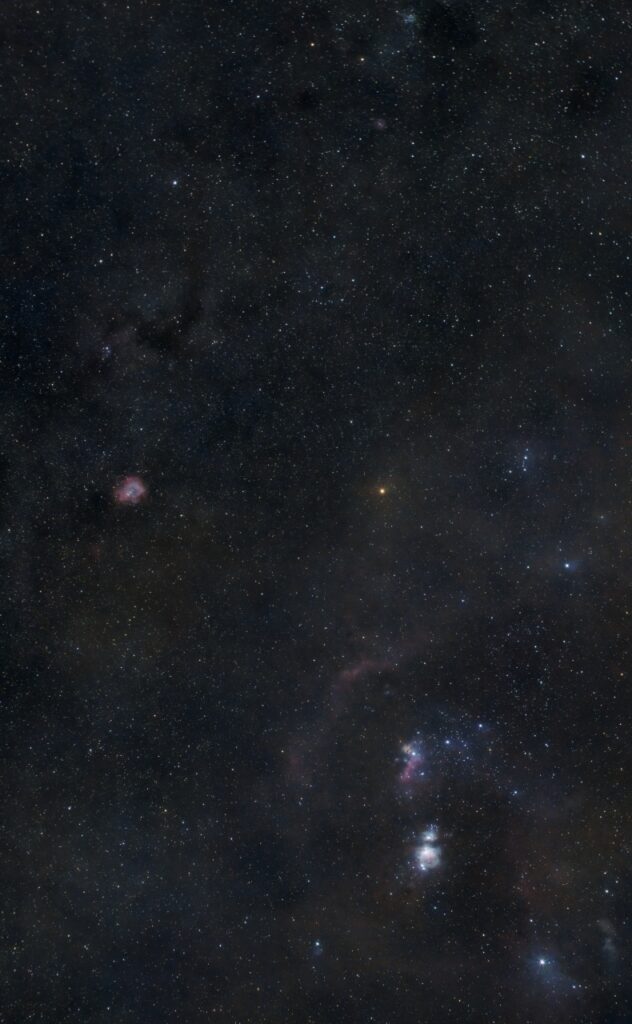
Orion Wide Field Shot
There are several objects visible in this wide field shot. Orion sits just off the plane of the Milky Way from our perspective. You can see many clouds of nebulosity that inhabit this region. Starting at the bottom right, the bright star Rigel shines with 60000 times the brightness of the sun. Just to its right is a gray faint nebulosity at the very edge of the image called the Witch’s Head Nebula. Moving up the image from Rigel is the Great Orion Nebula. Above that is the belt with its three bright stars, (L to R), Alnitak, Mintaka, and Alnilam. Surrounding Alnitak is the Flame nebula with yellowish color and the horsehead nebula the red color.
To the left you can see a ring of red that extends from above the belt all the way to Rigel. This is known as Bernard’s Loop. Moving left in the center toward the edge is the Rosette Nebula sitting in the middle of the plane of the Milky Way with the Cone Nebula and Christmas Tree Cluster visible as the faint glow just above the Rosette.
One can begin to see the dust lanes of the Milky Way from the Rosette on towards the top of the image with the open cluster Messier 35 at the very top center. The most famous star in the news today is Betelgeuse, the closest Hyper Giant star to us. Scientists believe it is at the end of its life and expect it to go supernove sometime in the near future. Could be tomorrow or 100,000 years from now. It is hard to imagine how colossal this star is. If it were in the center of the solar system, it would engulf the inner planets out to the orbit of Jupiter!
The Great Orion Nebula
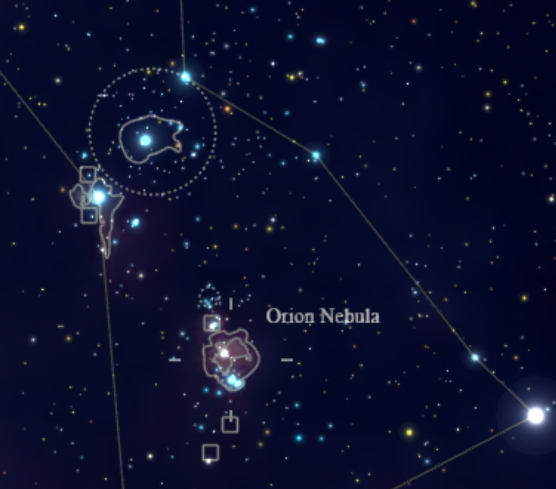
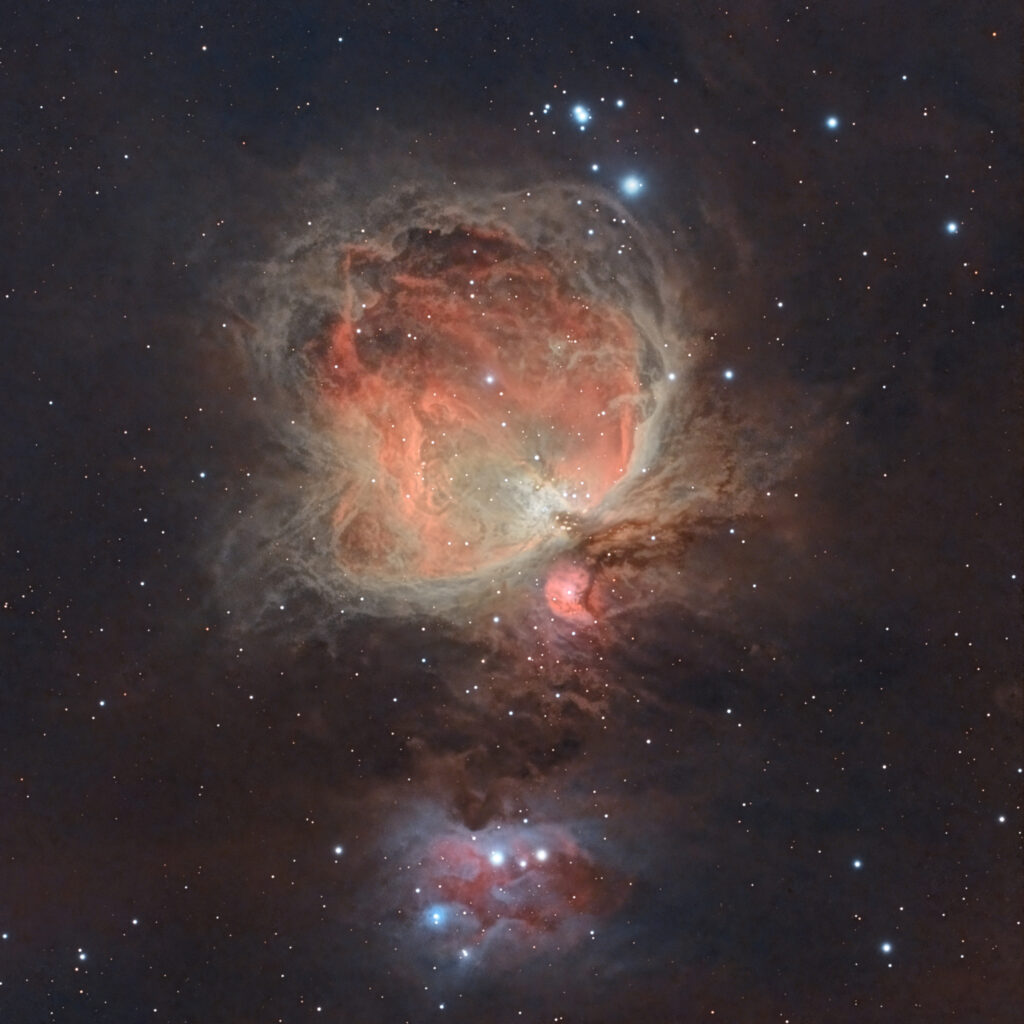
The Orion Nebula, catalogued as Messier 42 or NGC 1976, is one of the brightest nebulae in the sky, and one of the nearest star-forming regions to Earth. M 42 is visible to the naked eye as a hazy patch surrounding Theta Orionis, the middle star in the Sword of Orion, just south of Orion’s Belt.
M 42 is the closest region of massive star formation to Earth. The youngest and brightest stars we now see in the Orion Nebula are thought to be less than 100,000 years old. Some of these newborn stars are particularly massive, and emit large quantities of ionizing ultraviolet radiation. The ultraviolet light of these hot stars causes the nebula to glow by fluorescence.
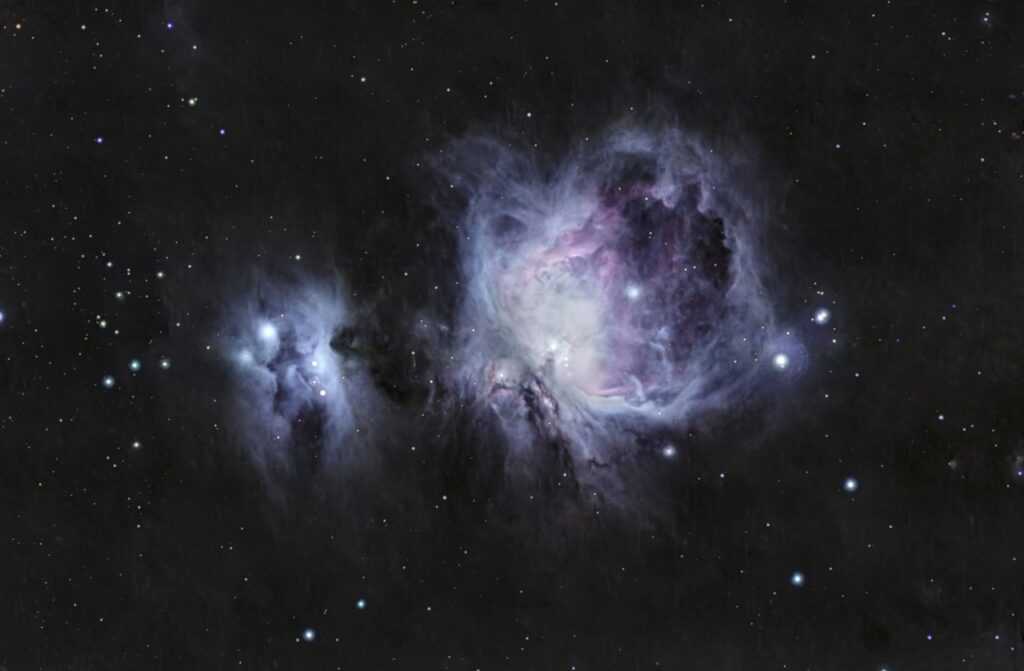
Orion's Belt, the Flame nebula and the horsehead nebula
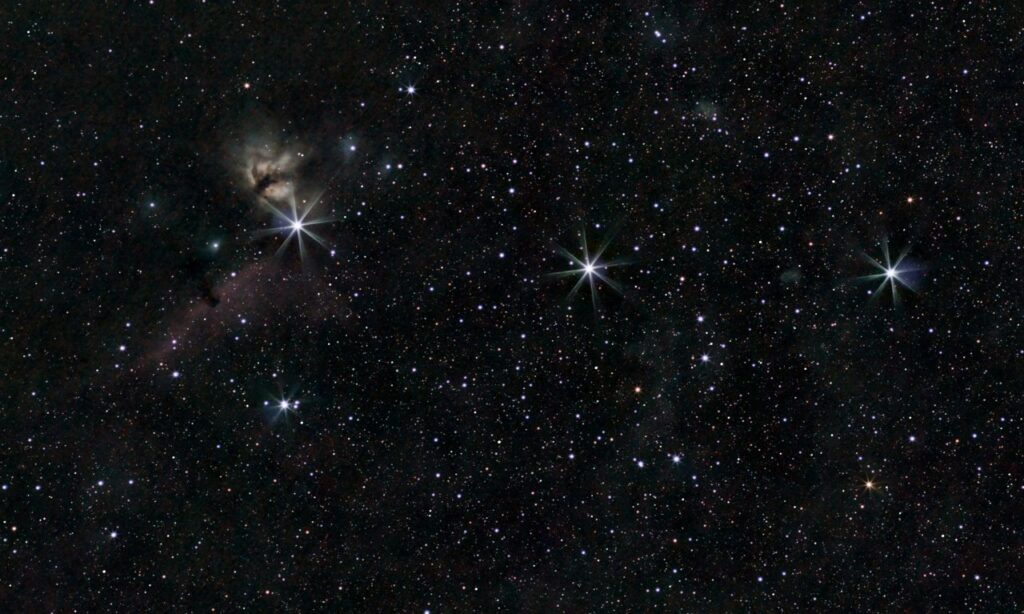
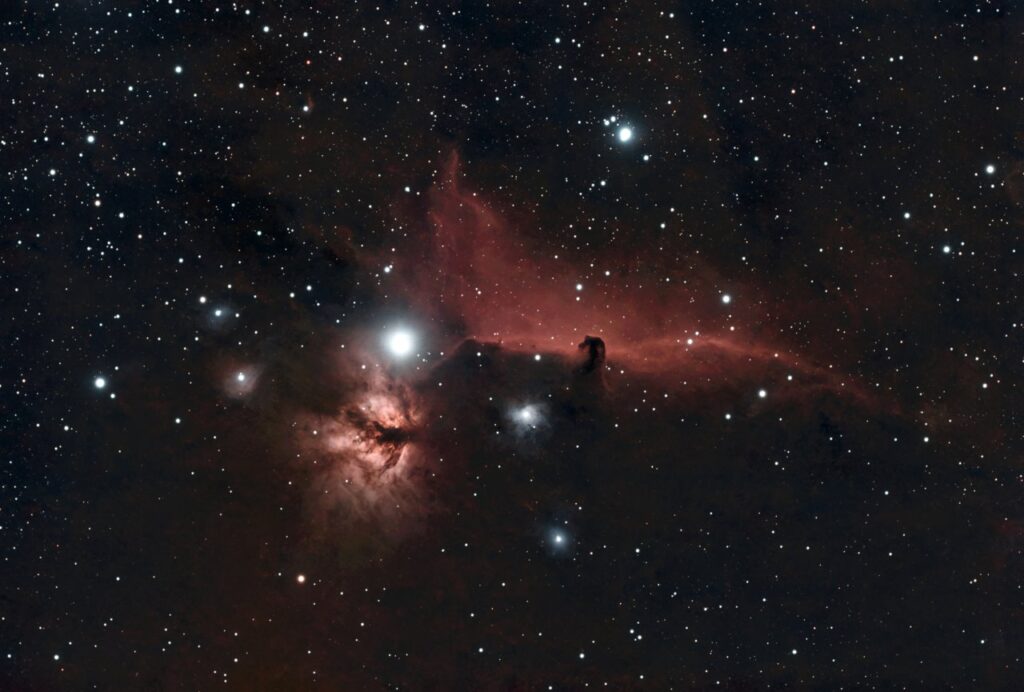
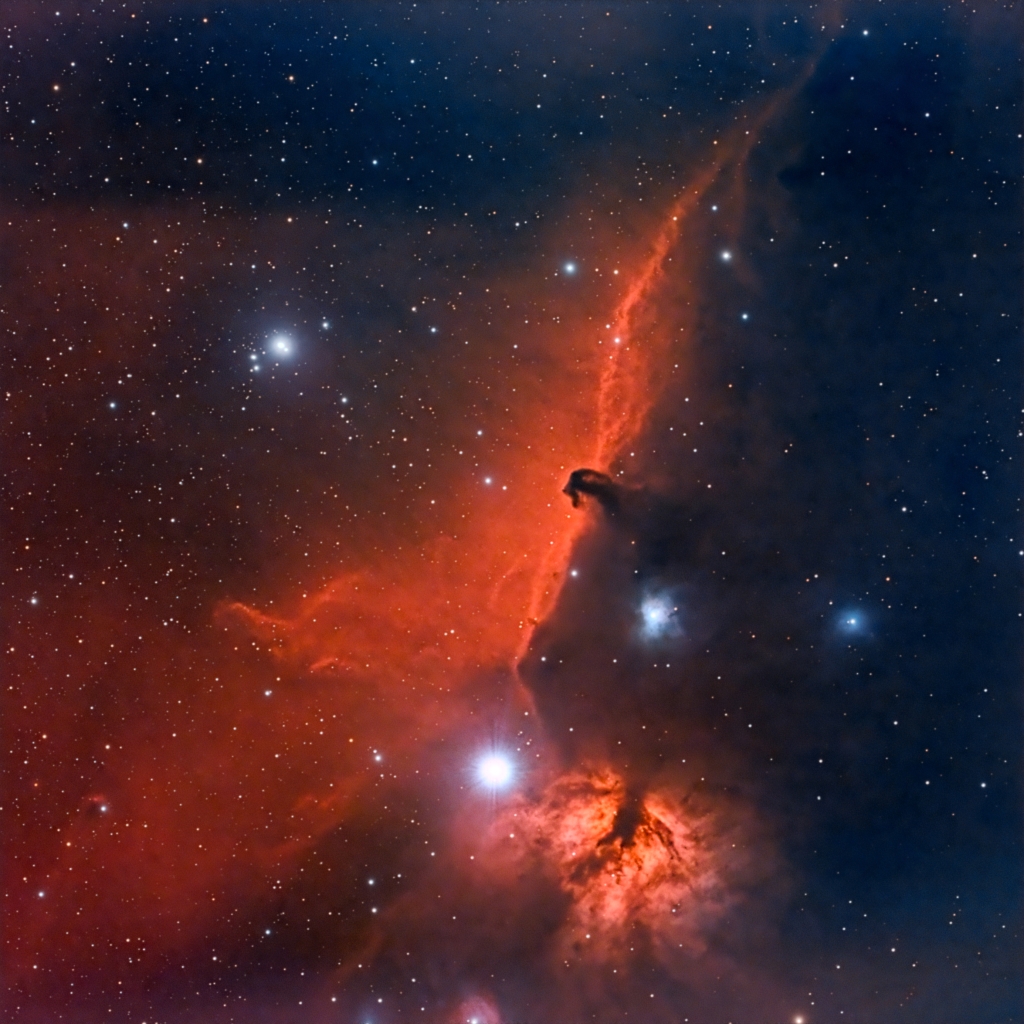
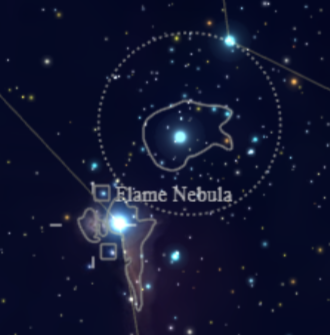
The Flame Nebula is about 900 light-years away, and is part of the Orion Molecular Complex, a star-forming region that includes the famous Horsehead Nebula. NGC 2024 is ionized and made to luminesce by the easternmost star in Orion’s Belt, Alnitak (ζ Ori). The Horsehead nebula likes just below and to the left of the bright star Alnitak. It is formed by dusk clouds that lie between Earth and the glowing gas, giving it a horse head appearance. With at 200mm lens, used in this photo it is just visible.
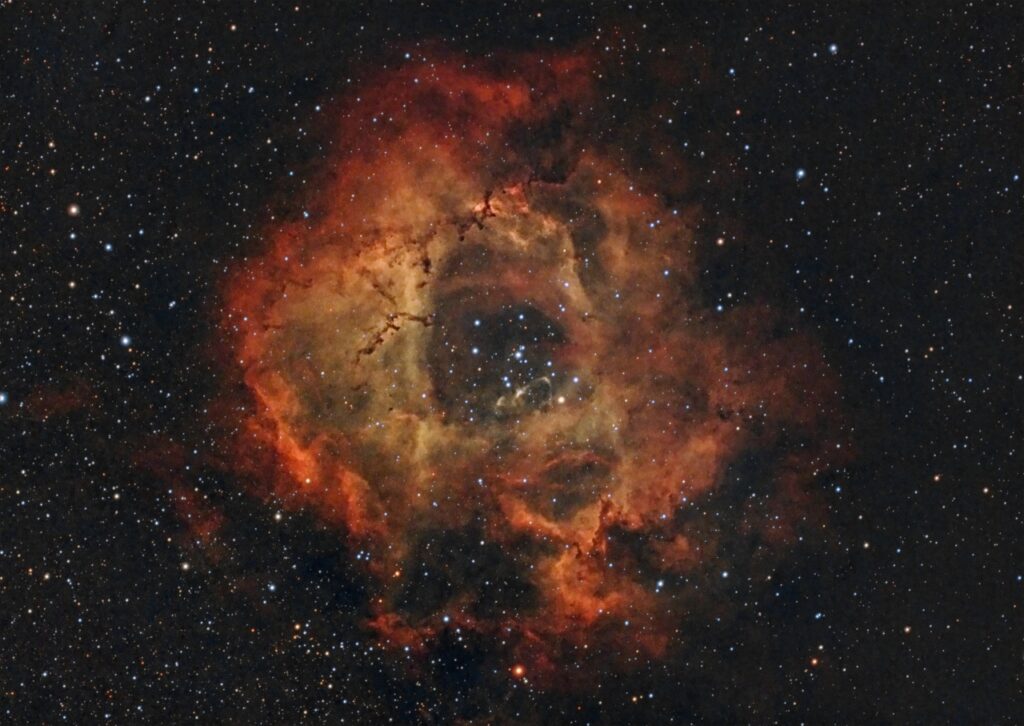
The rosette nebula
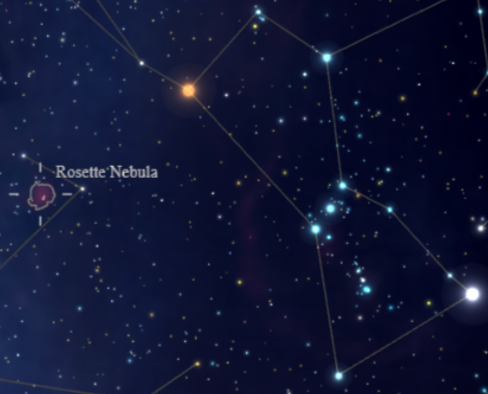
The Rosette Nebula is a large, circular emission nebula in the constellation Monoceros. It surrounds a cluster of hot, young stars known as the Rosette Cluster (NGC 2244). The Rosetta Nebula is a vast cloud of dust and gas extending over 1° across, and covers an area about 5 times that of the full moon.
The Rosette is at a distance of some 5,200 light years (though distance estimates vary considerably). Its diameter is about 130 light years, and the central hole is about 30 light years across. The nebula is estimated to contain around 10,000 solar masses.
The stars visible at the center are closely associated with the nebulosity, having recently formed from the nebula itself. Ultraviolet radiation from these hot O-type stars energizes the nebula, causing it to fluoresce.
Stellar winds from this group of stars have swept out the hollow at the center of the Rosette. These stellar winds exert pressure on the interstellar cloud, and compress it, leading to star formation, which is currently still ongoing in this vast cloud of interstellar matter
The Cone Nebula and The Christmas Tree Cluster (NGC2264)
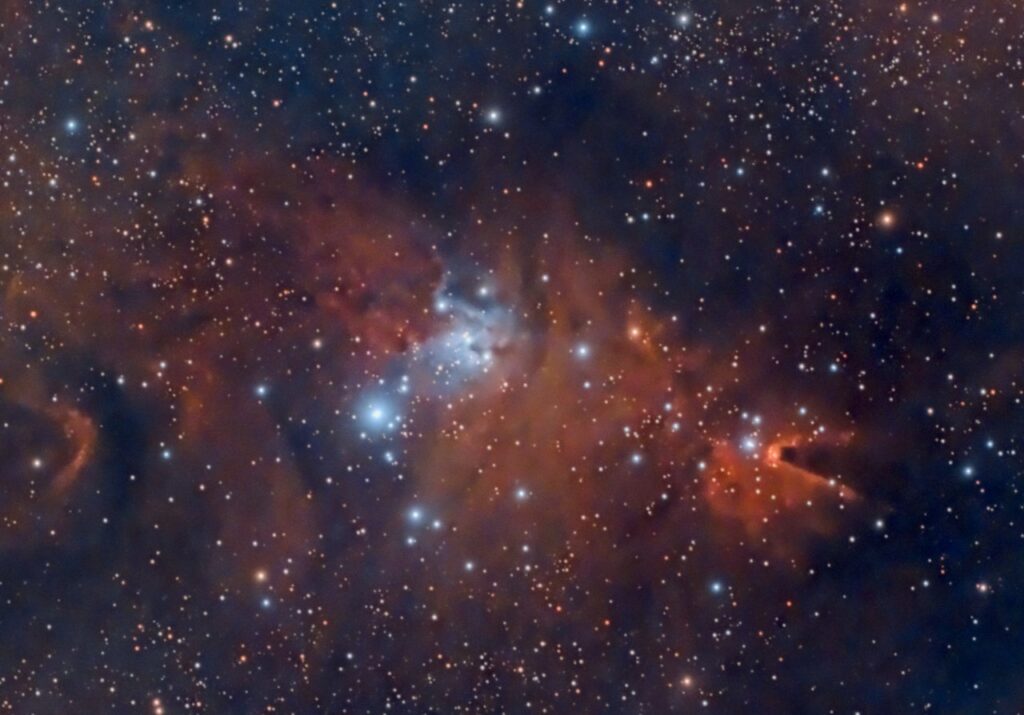
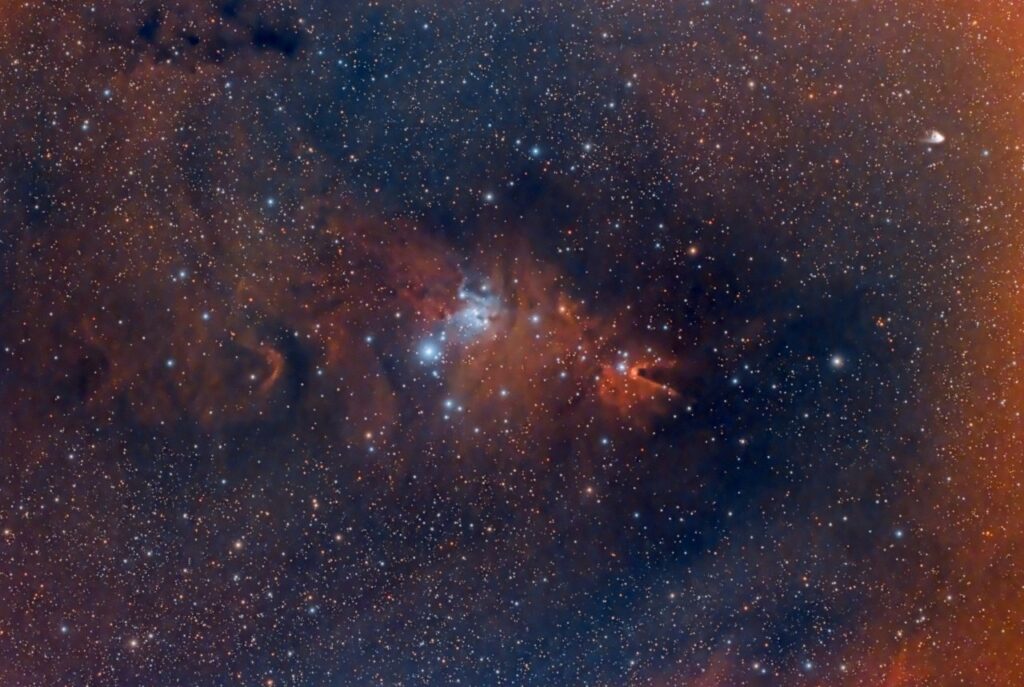
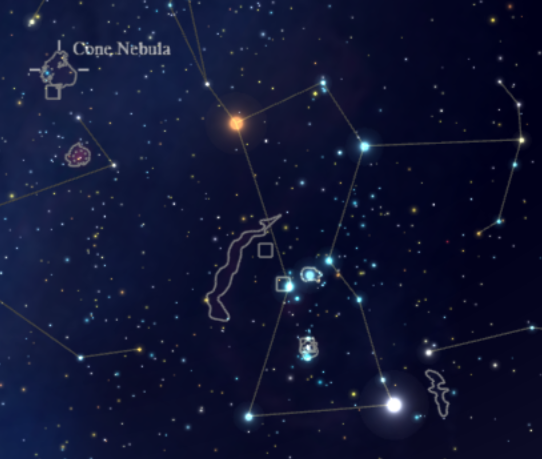
The Cone Nebula and Christmas Tree Cluster (NGC 2264) form a stunning star-forming region in the constellation Monoceros, about 2,500 light-years away. The Cone Nebula is a dark, pillar-like cloud of cold gas and dust sculpted by intense radiation and stellar winds from young, massive stars. Just above the Cone, the Christmas Tree Cluster is an open cluster of bright, hot stars illuminating the surrounding nebula with a bluish glow. At its heart lies S Monocerotis (S Mon), a massive, blue-white O-type star some 30 times the mass of the sun, that is the primary source of ionizing radiation in the region. S Mon is highly luminous, two hundred thousand times brighter than the Sun, and its powerful stellar winds help shape the surrounding nebula, triggering further star formation.
IC 443, The Jellyfish Nebula - supernova remnant
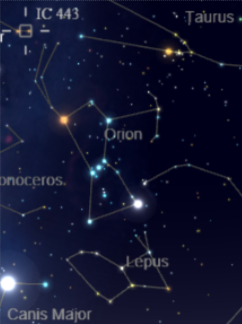
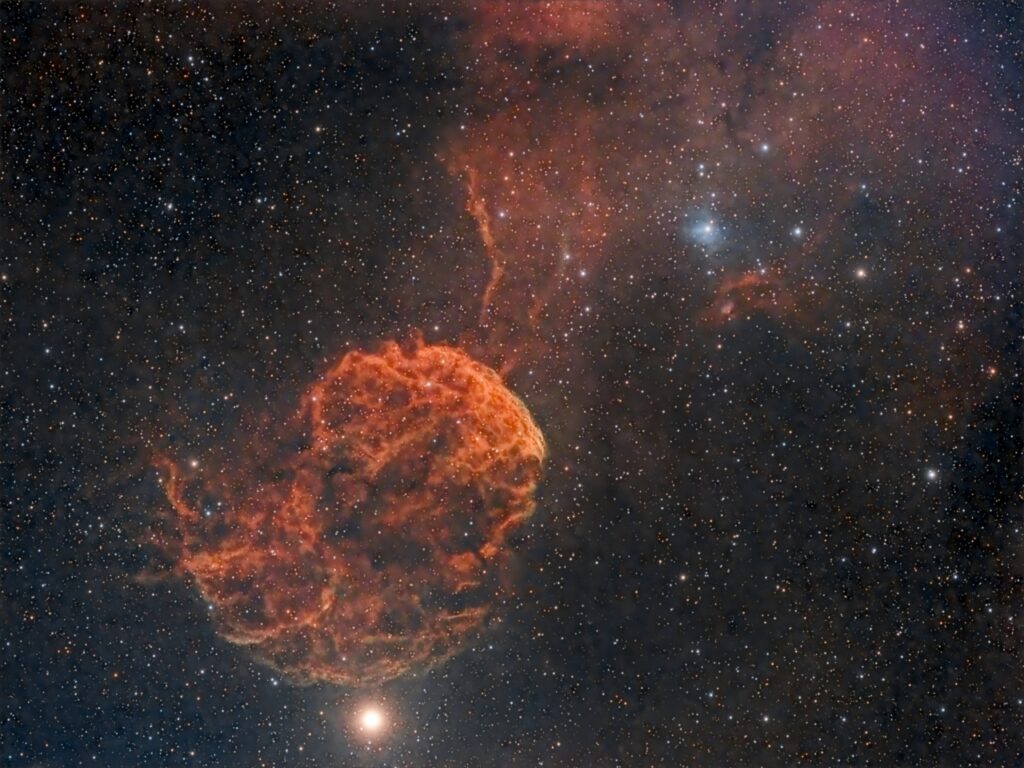
IC 443, commonly known as the Jellyfish Nebula, is a large and complex supernova remnant located in the constellation Gemini, near the bright star Eta Geminorum. It lies at a distance of roughly 5,000 light-years from Earth and spans about 70 light-years across, making it one of the most extended and well-studied remnants in the night sky. Unlike emission nebulae powered by living stars, IC 443 is the expanding debris cloud left behind after a massive star ended its life in a catastrophic supernova explosion.
-
-
Green, D. A. — Catalogue of Galactic Supernova Remnants (IC 443 parameters)
NGC 2174, The Monkey Head Nebula
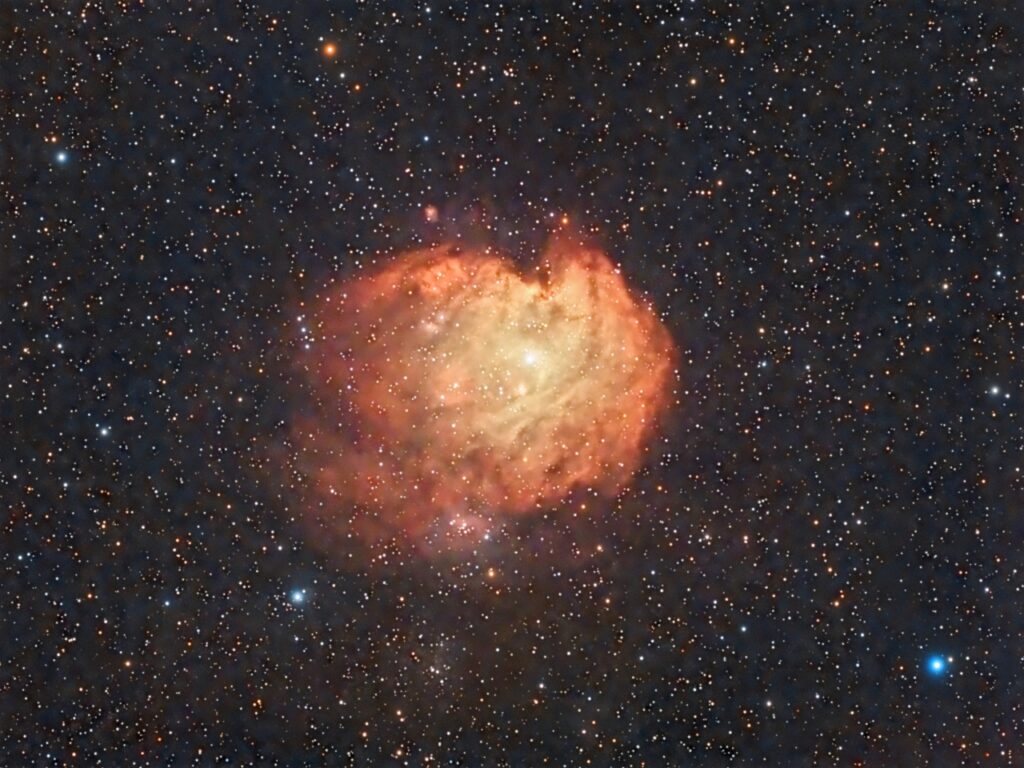
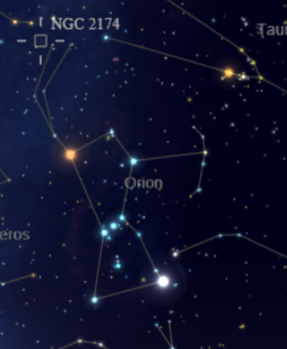
NGC 2174, popularly known as the Monkey Head Nebula, is an expansive emission nebula located in the constellation Orion, near the border with Gemini and not far from the bright star Betelgeuse. The nebula lies at a distance of roughly 6,400–6,500 light-years from Earth and spans more than 50 light-years across. Its nickname comes from the characteristic profile formed by dark dust lanes cutting into the glowing gas, which in deep images resembles the face of a monkey looking off to the side.
IC405, The Flaming Star Nebula
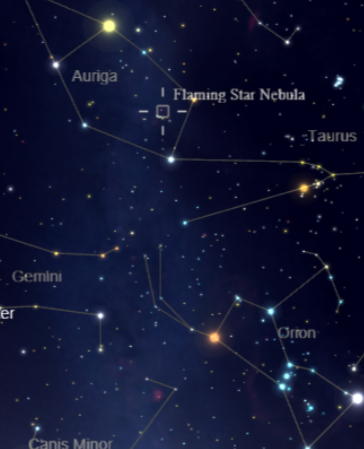
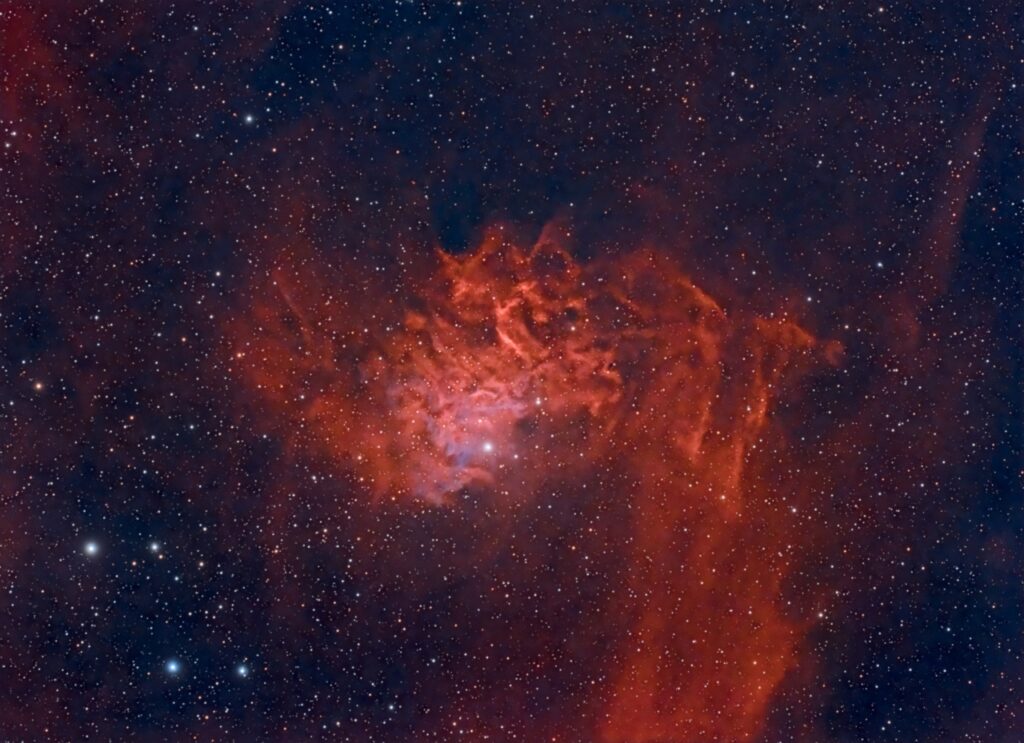
IC 405 and IC 410 form a physically related star-forming nebula complex in Auriga, seen in the same rich Milky Way field. IC 405 (the Flaming Star Nebula / Sh2-229 / Caldwell 31) is a mixed emission + reflection nebula whose glow and blue reflection haze are powered primarily by the embedded runaway star AE Aurigae (HD 34078). Modern distance estimates place IC 405 at roughly ~1,500 light-years (~460 pc), putting it in the foreground of the more distant Auriga star-forming regions. IC 405 was discovered photographically on 21 March 1892 by Johann Martin Schäberle (with later photographs the same year by Max Wolf and Eugen von Gothard), which is a nice historical reminder of how early astrophotography rapidly expanded the nebula catalog beyond what visual observers could reliably detect.
The Pleiades
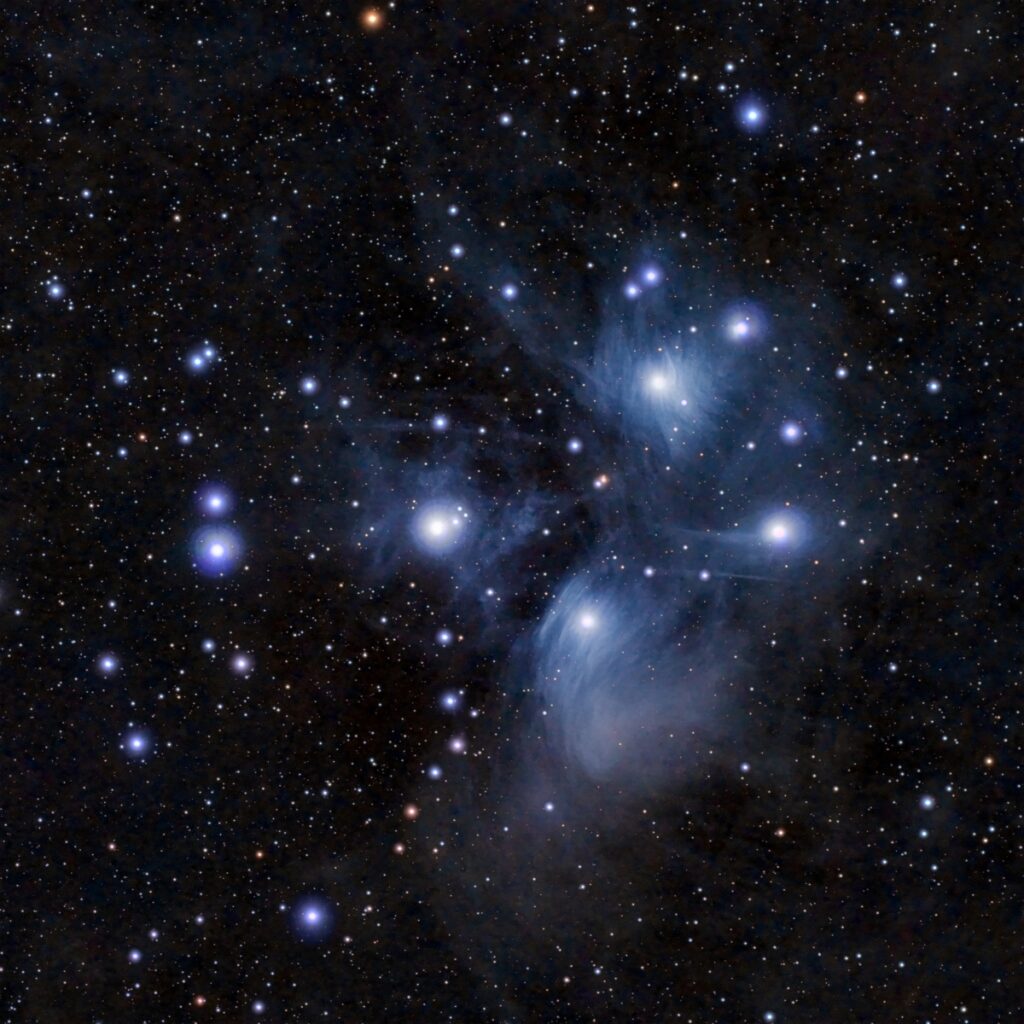
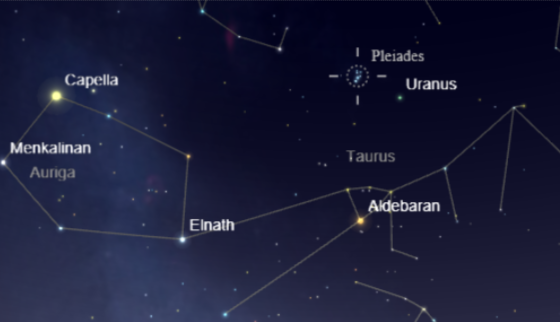
Messier 45, commonly known as the Pleiades or the Seven Sisters, is one of the most recognizable and beloved star clusters in the night sky. Located in the constellation Taurus, the cluster lies approximately 444 light-years from Earth and shines at an apparent magnitude of about 1.6, making it easily visible to the naked eye. Under dark skies, six or seven stars can typically be seen without optical aid, though binoculars or a small telescope reveal dozens more scattered across a region roughly 8 light-years in diameter.
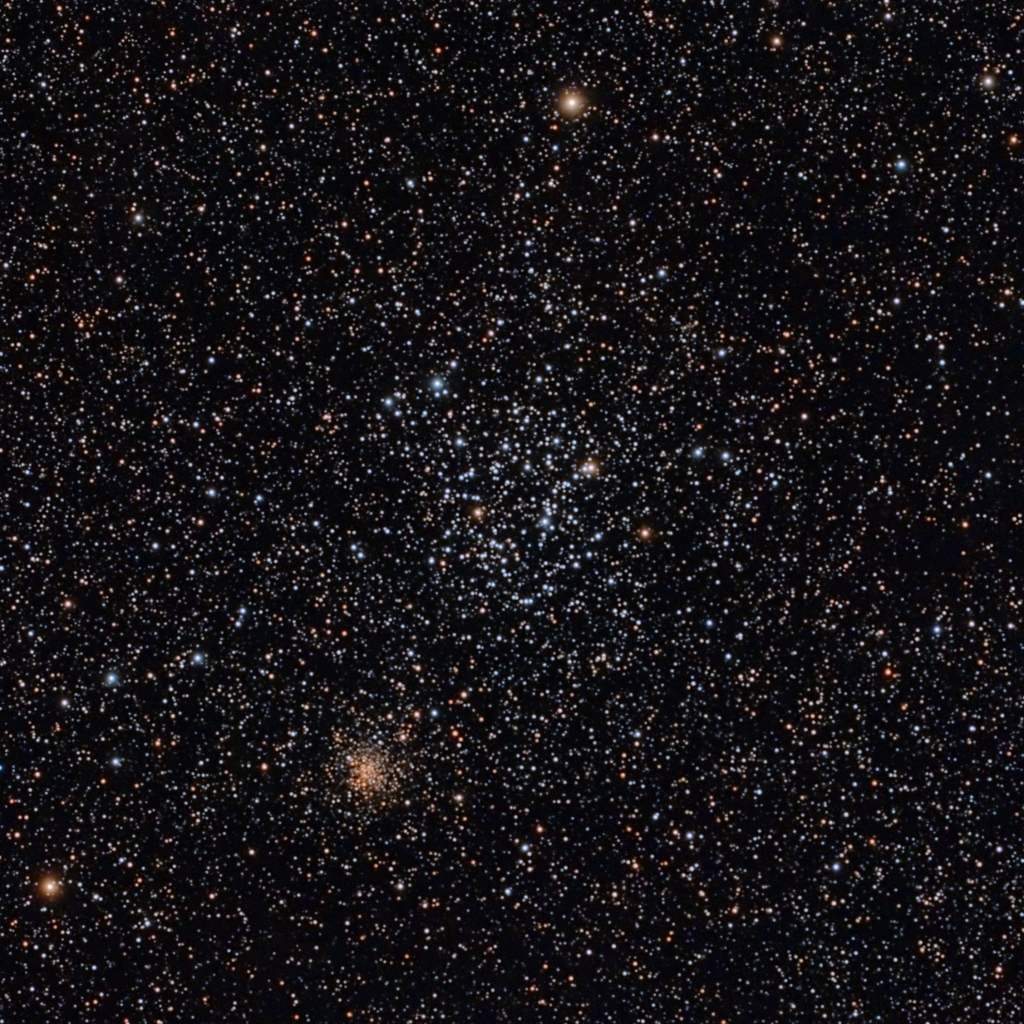
Messier 35 and NGC2158
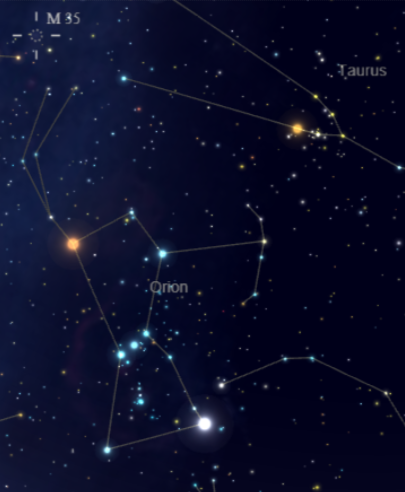
Messier 35 (M35) is a rich open cluster located in the constellation Gemini, near the foot of Castor. Positioned approximately 2,800 light-years from Earth, it shines at an apparent magnitude of about 5.1 and spans nearly 24 light-years across. Discovered by Philippe Loys de Chéseaux in 1745 and later cataloged by Charles Messier, M35 contains several hundred confirmed member stars, with estimates exceeding 1,000 when faint members are included. Through binoculars or a small telescope, it appears as a loose, sparkling spray of stars, bright and well resolved against the winter Milky Way.
Just southwest of M35 lies NGC 2158, a much older and more distant open cluster that provides a striking contrast. Located about 16,000 light-years away, NGC 2158 is approximately 1–2 billion years old. In small telescopes it appears as a faint, condensed glow, but higher magnification reveals a tightly packed swarm of dimmer stars. Its advanced age means many of its more massive stars have evolved into red giants, giving the cluster a subtly warmer tone compared to the youthful sparkle of M35. Together, these two clusters offer a compelling visual lesson in stellar evolution—one young and loosely structured, the other ancient and compact—sharing the same line of sight yet separated by vast distances in space.