

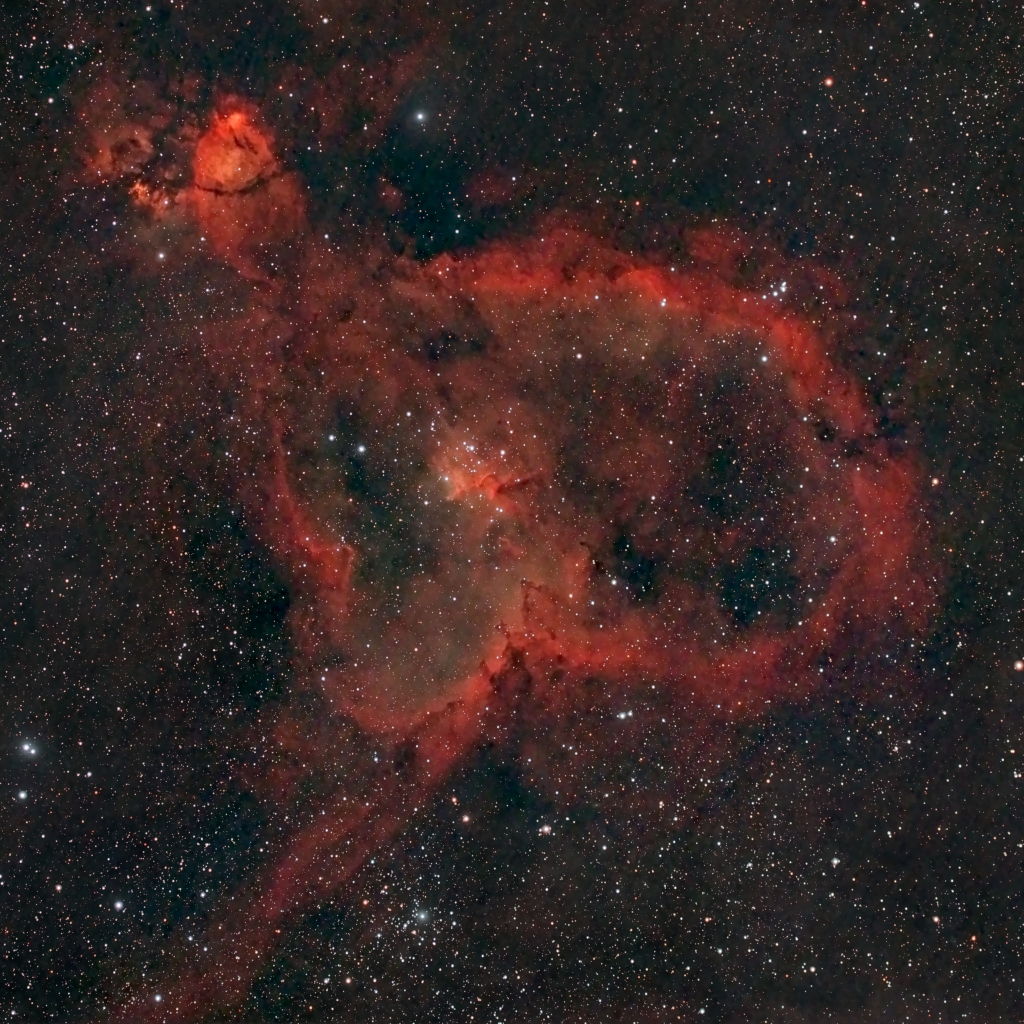
IC 1805 – The Heart Nebula
August 2025
IC 1805, the Heart Nebula, is a large H II emission nebula in the constellation Cassiopeia, situated along the line of sight to the Perseus Arm and forming the western half of the well-known Heart and Soul star-forming complex. The nebula is typically placed at a distance of roughly ~7,000–7,500 light-years (≈2.1–2.3 kpc), with an apparent size near ~150′ × 150′—corresponding to a physical scale on the order of ~150–170 light-years across. Its glow is dominated by ionized hydrogen (strong Hα emission) traced by dark, sculpting dust lanes, with prominent substructure including the bright knot NGC 896 and the nearby “Fish Head” region often associated with IC 1795.
At the nebula’s core lies the young open cluster Melotte 15 (also associated in the literature with IC 1805 / Collinder 26), whose massive O- and early B-type stars provide the ultraviolet radiation that powers the H II region. Detailed spectroscopy of the brightest members highlights the presence of extremely hot, luminous stars (including HD 15570, HD 15629, and the multiple system HD 15558, with components classified around O5–O8 in published analyses). Cluster age estimates commonly fall in the ~1–3 million year range, consistent with the survival of very massive O stars and the strong ongoing feedback—stellar winds and radiation—that carves cavities, compresses adjacent cloud edges, and helps generate the sharp ionization fronts and pillar-like dust features seen throughout the Heart.
Historically, the Heart Nebula region was discovered by William Herschel on 3 November 1787, initially through its brightest portions, which is why the conspicuous knot NGC 896 has its own entry separate from the wider complex. In the radio era, the Heart Nebula became part of the broader outer-Galaxy star-forming environment mapped as Westerhout 4 (W4), identified as a prominent radio source in 1958—a key step in linking optical nebulae to large, energetic structures in the interstellar medium. Together with the neighboring W3/W5 regions, IC 1805/W4 remains an important benchmark for studying massive-star feedback, the shaping of giant H II regions, and the relationship between embedded clusters and the surrounding molecular cloud reservoirs that fuel subsequent star formation.
Sources & References
- Wikipedia — Heart Nebula (IC 1805 / Sh2-190 / W4): distance, size, discovery date/by whom, identifiers
https://en.wikipedia.org/wiki/Heart_Nebula - Straižys et al. (2013), Astronomy & Astrophysics — IC 1805 / Melotte 15 cluster study; age range and cluster properties
https://www.aanda.org/articles/aa/full_html/2013/06/aa21029-13/aa21029-13.html - De Becker et al. (2006), Astronomy & Astrophysics — early-type (O-star) content and multiplicity in IC 1805 (HD 15570, HD 15629, HD 15558)
https://ui.adsabs.harvard.edu/abs/2006A%26A…456.1121D/abstract
https://www.aanda.org/articles/aa/pdf/2006/36/aa5300-06.pdf - SIMBAD — IC 1805 object page (cross-identifications and literature links)
https://simbad.u-strasbg.fr/simbad/sim-id?Ident=IC+1805 - GalaxyMap “Things Unseen” — Westerhout (W) radio-source context; W3/W4/W5 association with Heart/Soul region
https://galaxymap.org/drupal/node/32
Project Details
-
Belleville, MI
-
ZWO FF65, FL = 416mm, f6.4, Pentax K3ii, 13h22m Total Integration Time