

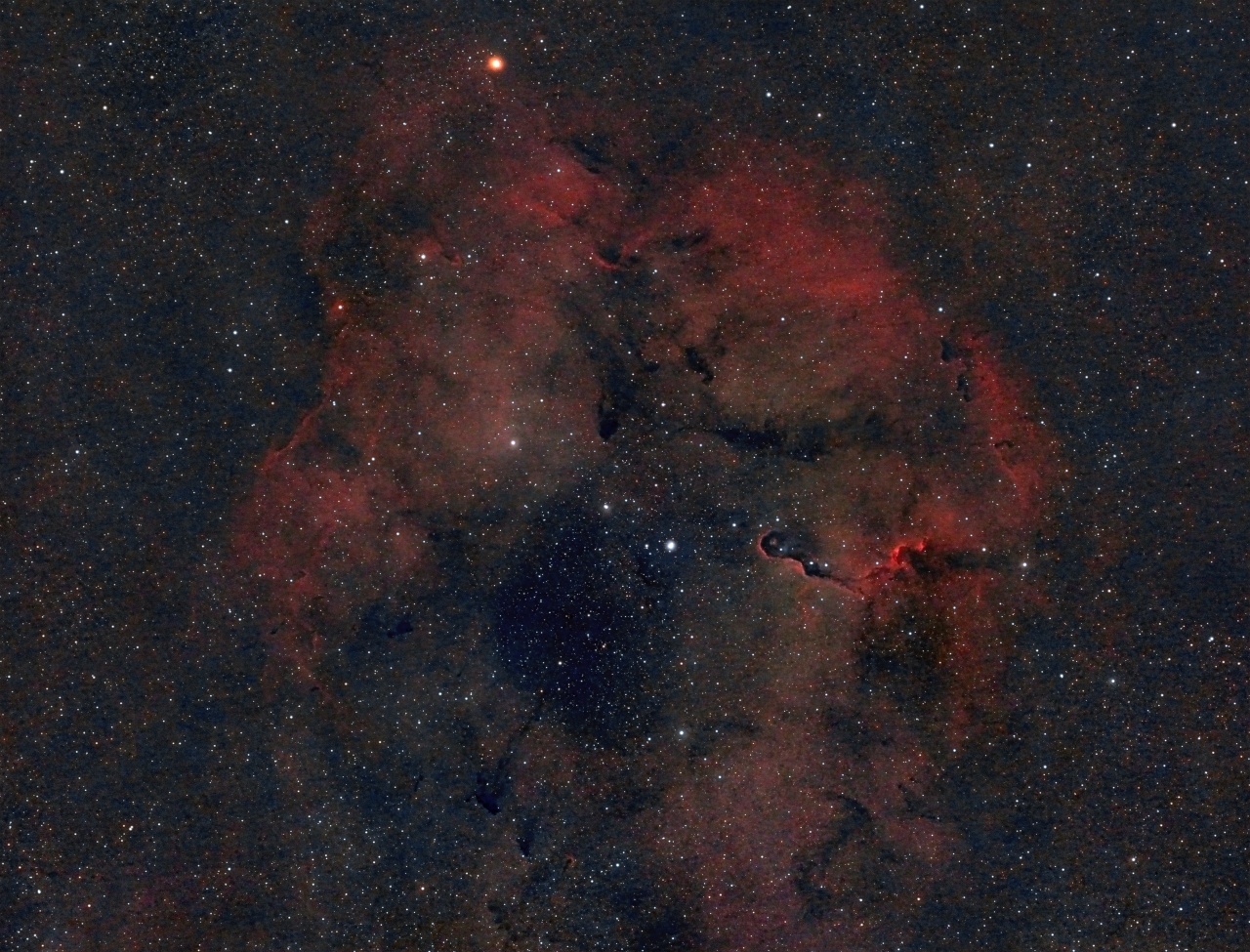
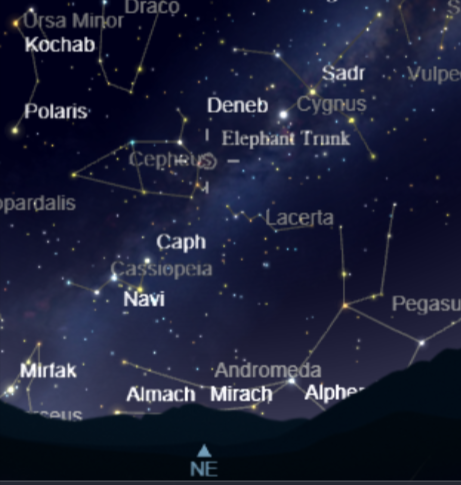
IC1396 – Elephant Trunk Nebula
Belleville, MI
07/28-29/25
VIC 1396 is a sprawling emission nebula and star-forming complex in Cepheus, spanning well over 100 light-years and sitting roughly ~2,400 light-years away. Along its rim lies IC 1396A, the famous Elephant Trunk Nebula—a dense, dusty globule whose dark “trunk” stands out in silhouette against the surrounding glow. The overall scene is a classic H II region: a large volume of interstellar hydrogen gas ionized by nearby massive stars, with pockets of thicker dust and molecular material resisting that radiation long enough to form pillars, globules, and embedded star nurseries.
The primary engine shaping IC 1396 is the bright central multiple-star system HD 206267, the dominant ionizing source for the region and the stellar anchor of the young cluster Trumpler 37. HD 206267 is an O-type system (often described as O6–O6.5) with blistering surface temperatures—its hottest component is listed around ~41,000 K—and extreme luminosity (hundreds of thousands of Suns). This intense ultraviolet radiation creates the nebula’s broad H-alpha glow and drives energetic stellar winds that erode and compress nearby clouds, carving bright ionization fronts and pushing shock-like boundaries into denser material.
The Elephant Trunk itself is a prime example of how massive stars can both destroy and trigger star formation. Its bright rim marks the surface being ionized and heated, while the interior remains colder and dustier, sheltering collapsing clumps and very young stars revealed strongly in infrared and X-ray studies. Over time, the radiation from HD 206267 photo-evaporates the globule, but the same pressure and compression along the rim can accelerate collapse in the densest cores—so the “trunk” becomes both a sculpture in progress and a cradle for the next stellar generation.
Mu Cephei (μ Cep)—the famous Garnet Star—adds an entirely different kind of astrophysical drama to the same neighborhood. A deep red M2 Ia red supergiant (often discussed as a red hypergiant candidate), μ Cephei sits near the edge of the IC 1396 complex and is a semi-regular variable visible to the naked eye under good skies. It has an effective temperature around ~3,750 K, an enormous radius on the order of ~1,200–1,400 times the Sun’s, and an estimated distance commonly given in the ~2,100–3,100 light-year range. Historically, its spectrum has served as a spectral standard for classifying other cool stars—an important scientific role for a star that also happens to be one of the sky’s most strikingly colored.
Sources & References
Wikipedia — Mu Cephei (spectral type, temperature, size range, variability, distance range; “Garnet Star” and spectral standard note). Wikipedia
Wikipedia — IC 1396 (distance; ionization by HD 206267; regional context). Wikipedia
Wikipedia — Elephant’s Trunk Nebula (IC 1396A) (location within IC 1396; illuminated/ionized rim; star formation notes). Wikipedia
Wikipedia — HD 206267 (O-type multiple system; temperatures and basic stellar parameters; system description). Wikipedia
Sicilia-Aguilar et al. 2014, Astronomy & Astrophysics — Herschel view of IC 1396A (HD 206267 as main ionizing source; O6.5 classification referenced). A&A
Deep Sky Corner — IC 1396 (Gaia-based distance note and spatial relationship between HD 206267 and the nebular structures). Deep Sky Corner
Project Details
-
Belleville, MI
-
ZWO FF65 telescope, .75 reducer, FL = 308mm, f4.8, Pentax K3ii, iso500, Antlia Triband Filter, 4 minute subs, 10h22m integration time