

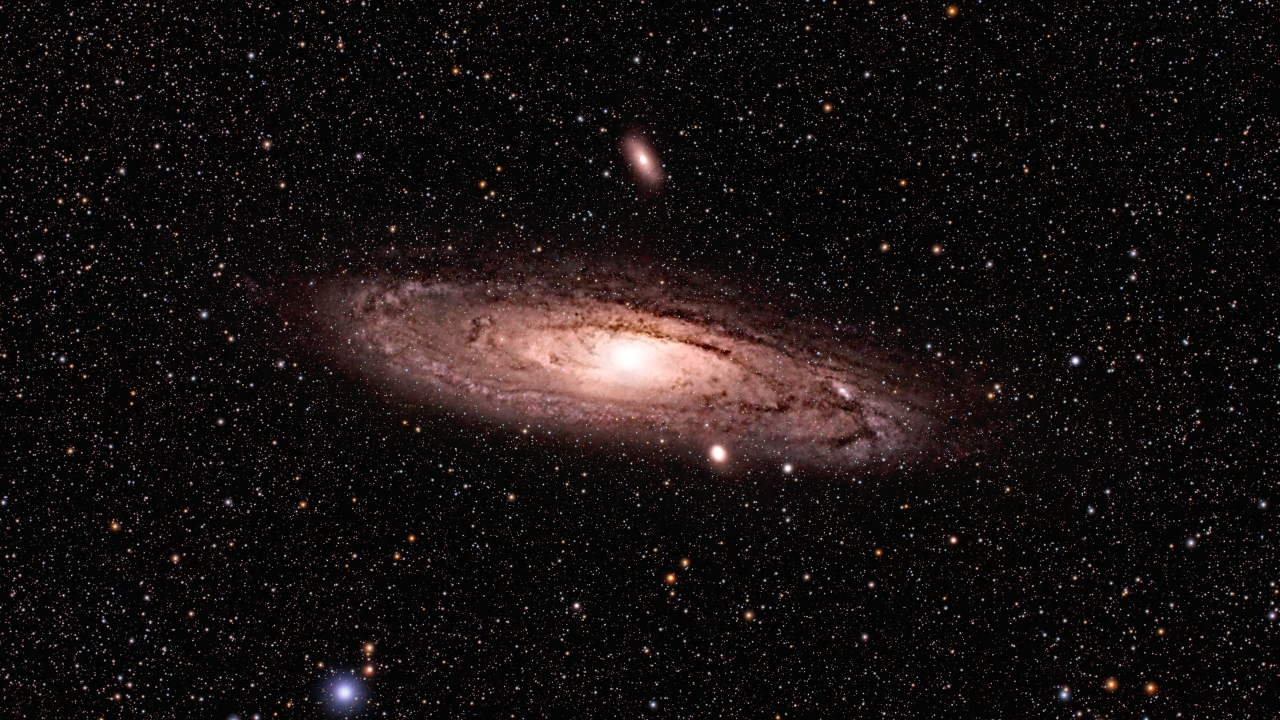
The great Andromeda Galaxy – M31
October 2025
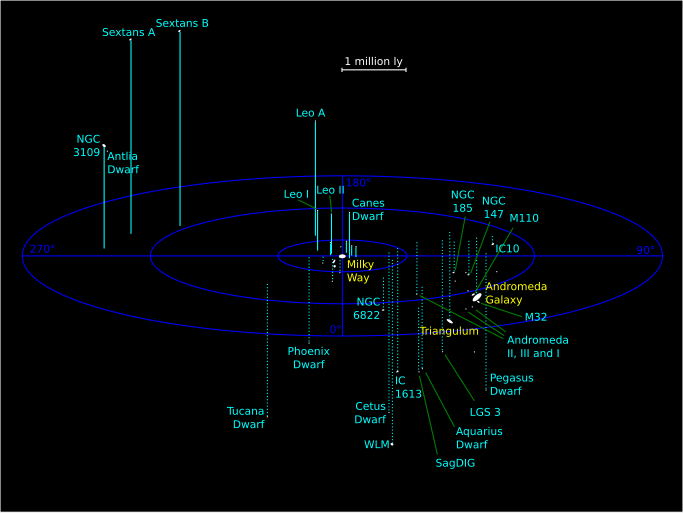
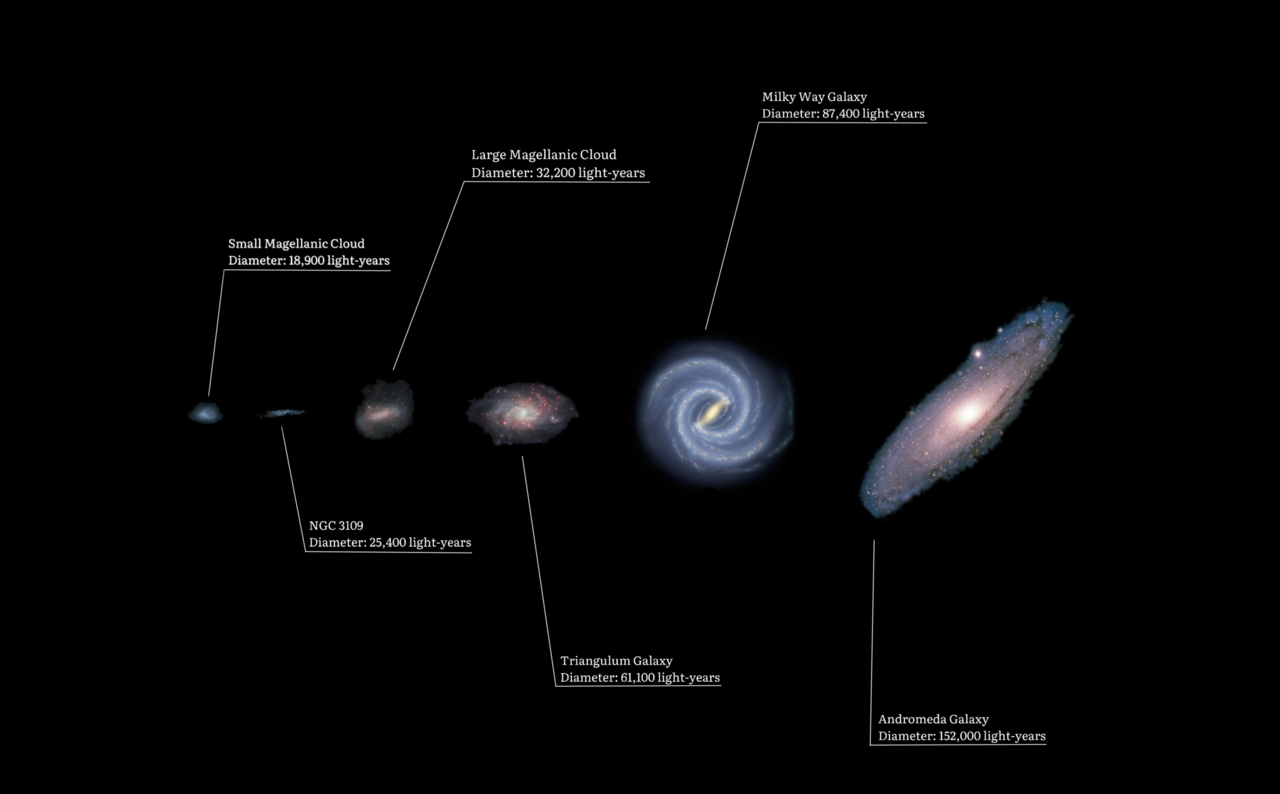
M31, the Andromeda Galaxy, is a massive barred spiral galaxy (SA(s)b) in the constellation Andromeda and the largest member of the Local Group, which also includes the Milky Way and M33. Its distance is well constrained at approximately 2.5–2.6 million light-years (≈780–800 kpc), making it the nearest large spiral galaxy to our own. With an optical diameter of roughly 220,000 light-years, M31 is significantly larger than the Milky Way and contains an estimated ~1 trillion stars. Its prominent disk, dust lanes, extended halo, and rich system of satellite galaxies make it a cornerstone object for studies of galactic structure and evolution.
M31 hosts a complex and diverse stellar population. Its disk contains numerous star-forming regions, while the central bulge is dominated by older, metal-rich stars. One of its most notable features is the double nucleus (often labeled P1 and P2), interpreted as stars orbiting a central supermassive black hole with a mass of about 1–2 × 10⁸ solar masses. The galaxy is also rich in globular clusters, with well over 400 confirmed members, providing a powerful comparative dataset for understanding globular cluster formation and chemical evolution. Studies of Cepheid variables, red giant branch stars, and eclipsing binaries in M31 have played a major role in refining the extragalactic distance scale.
Historically, M31 was first described as a “little cloud” by the Persian astronomer Abd al-Rahman al-Sufi in 964 CE, and later cataloged telescopically by Simon Marius in 1612. It entered modern catalogs as Messier 31 in 1764. M31’s scientific importance is profound: Edwin Hubble’s 1920s discovery of Cepheid variables in Andromeda provided decisive evidence that it lies far outside the Milky Way, fundamentally expanding the known scale of the universe. Today, precise proper-motion measurements show that M31 is on a slow collision course with the Milky Way, expected to merge in roughly 4–5 billion years, making it not only a key object for understanding galaxy evolution—but also the future of our own Galactic environment.
Sources & References
- NASA Science — Hubble Messier Catalog: Messier 31 overview
https://science.nasa.gov/mission/hubble/science/explore-the-night-sky/hubble-messier-catalog/messier-31/ - SEDS Messier Pages — M31 (NGC 224) detailed summary
https://www.messier.seds.org/m/m031.html - Wikipedia — Andromeda Galaxy (M31): distance, size, stellar population, black hole, discovery history
https://en.wikipedia.org/wiki/Andromeda_Galaxy - HubbleSite — Edwin Hubble and Cepheids in M31 (extragalactic distance scale)
https://hubblesite.org/contents/articles/the-discovery-of-the-expanding-universe - van der Marel et al. (2012), Astrophysical Journal — M31–Milky Way proper motion and future merger
https://iopscience.iop.org/article/10.1088/0004-637X/753/1/8
Project Details
-
Belleville, MI
-
ZWO FF65, FL=416mm, Pentax K3ii, f6.4, 16h40min Color, 2h5m Ha - Oiii Integration Time