

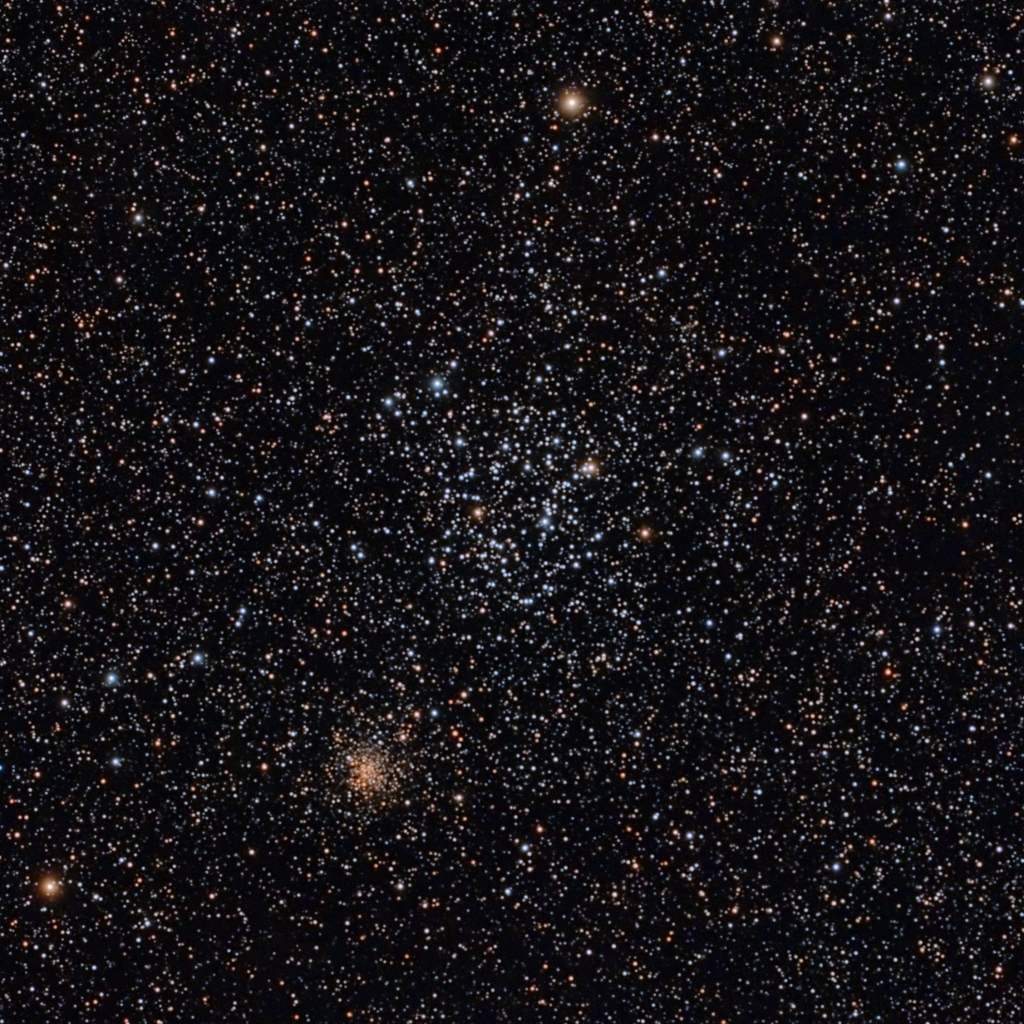
Messier 35 and NGC 2158
Messier 35 (M35) is a rich open cluster located in the constellation Gemini, near the foot of Castor. Positioned approximately 2,800 light-years from Earth, it shines at an apparent magnitude of about 5.1 and spans nearly 24 light-years across. Discovered by Philippe Loys de Chéseaux in 1745 and later cataloged by Charles Messier, M35 contains several hundred confirmed member stars, with estimates exceeding 1,000 when faint members are included. Through binoculars or a small telescope, it appears as a loose, sparkling spray of stars, bright and well resolved against the winter Milky Way.
M35 is relatively young, with an estimated age of roughly 100–150 million years—comparable to the Pleiades. Its stellar population includes numerous blue-white main-sequence stars along with a scattering of orange and red giants that have already evolved off the main sequence. The cluster’s size and brightness make it a rewarding visual target and a wide-field astrophotography subject, especially when framed alongside its more distant companion.
Just southwest of M35 lies NGC 2158, a much older and more distant open cluster that provides a striking contrast. Located about 16,000 light-years away, NGC 2158 is approximately 1–2 billion years old. In small telescopes it appears as a faint, condensed glow, but higher magnification reveals a tightly packed swarm of dimmer stars. Its advanced age means many of its more massive stars have evolved into red giants, giving the cluster a subtly warmer tone compared to the youthful sparkle of M35. Together, these two clusters offer a compelling visual lesson in stellar evolution—one young and loosely structured, the other ancient and compact—sharing the same line of sight yet separated by vast distances in space.
Sources
- SIMBAD Astronomical Database – M35 and NGC 2158
- WEBDA Open Cluster Database – Cluster parameters and ages
- Dias, W. S. et al. (2002, updated). New catalogue of optically visible open clusters and candidates. Astronomy & Astrophysics
- NASA/IPAC Infrared Science Archive (IRSA) – Open Cluster Data
Project Details
-
Belleville MI
-
ZWO FF65, FL = 416mm, f6.4; ZWO ASI294MCPro, Antlia Triband filter, 4 min subs, 2h integration time.