

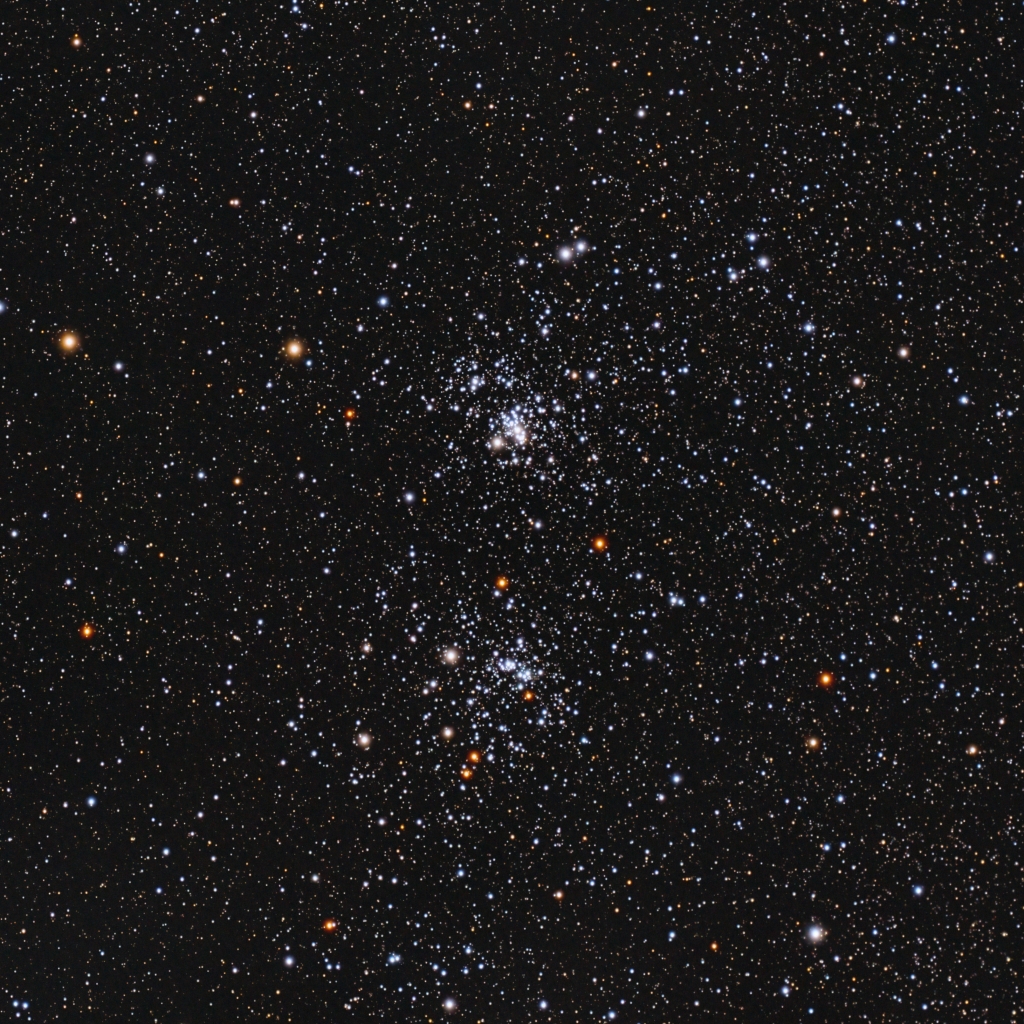
NGC 869 – NGC884 The Double Cluster
October 2025
NGC 869 & NGC 884 — The Double Cluster in Perseus
NGC 869 (h Persei) and NGC 884 (χ Persei) together form the famous Double Cluster, located in the constellation Perseus along the Perseus Arm of the Milky Way. Both clusters lie at a distance of approximately 7,500 light-years (≈2.3 kpc) and are physically associated with the Perseus OB1 stellar association. Age determinations based on main-sequence turnoff and stellar evolution modeling place both clusters at roughly 14 million years, classifying them as very young open clusters by Galactic standards.
The Double Cluster is dominated by hot, massive B-type stars, including very early spectral subclasses near B0, which produce the clusters’ intense blue coloration. Each cluster contains several hundred bright, massive members, with total stellar populations extending into the thousands when lower-mass stars are included. Notably, NGC 884 hosts several red supergiants, creating a striking color contrast and providing direct evidence of rapid stellar evolution among high-mass stars. The combination of early-type main-sequence stars and evolved supergiants makes the pair an important benchmark for studying massive star lifecycles.
The Double Cluster has been known since antiquity and was recorded by Hipparchus around 130 BCE, making it one of the earliest deep-sky objects recognized as distinct from individual stars. Its long observational history, combined with its youth and richness, has made it a cornerstone object for refining open-cluster age dating, stellar population synthesis, and high-mass stellar evolution models. Today, NGC 869 and NGC 884 remain among the most studied and visually impressive star clusters in the northern sky.
Sources & References
- SIMBAD Astronomical Database – NGC 869
https://simbad.u-strasbg.fr/simbad/sim-id?Ident=NGC+869 - SIMBAD Astronomical Database – NGC 884
https://simbad.u-strasbg.fr/simbad/sim-id?Ident=NGC+884 - NASA/IPAC Extragalactic Database (background & associations)
https://ned.ipac.caltech.edu - WEBDA Open Cluster Database (ages, membership, photometry)
https://webda.physics.muni.cz - Gaia Collaboration (cluster distance and membership studies)
https://www.cosmos.esa.int/web/gaia - ESA/Hubble — The Double Cluster in Perseus (educational overview)
https://esahubble.org/images/potw1346a/ - Burnham, R. Burnham’s Celestial Handbook, Vol. 2 (historical context)
Project Details
-
Belleville, MI
-
ZWO FF65, FL=416mm, Pentax K3ii, f6.4, 1h Total Integration time