

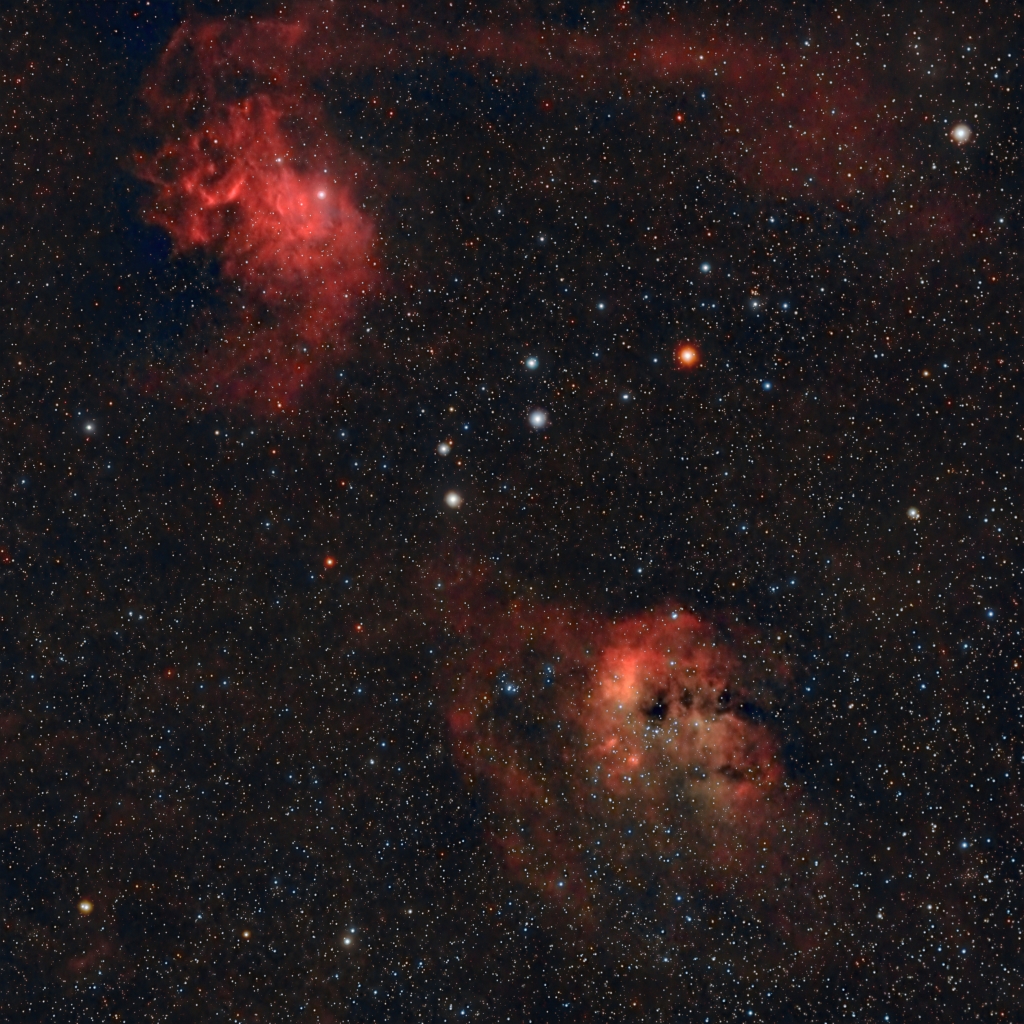
The Flaming star Nebula complex – IC 405 – IC 410
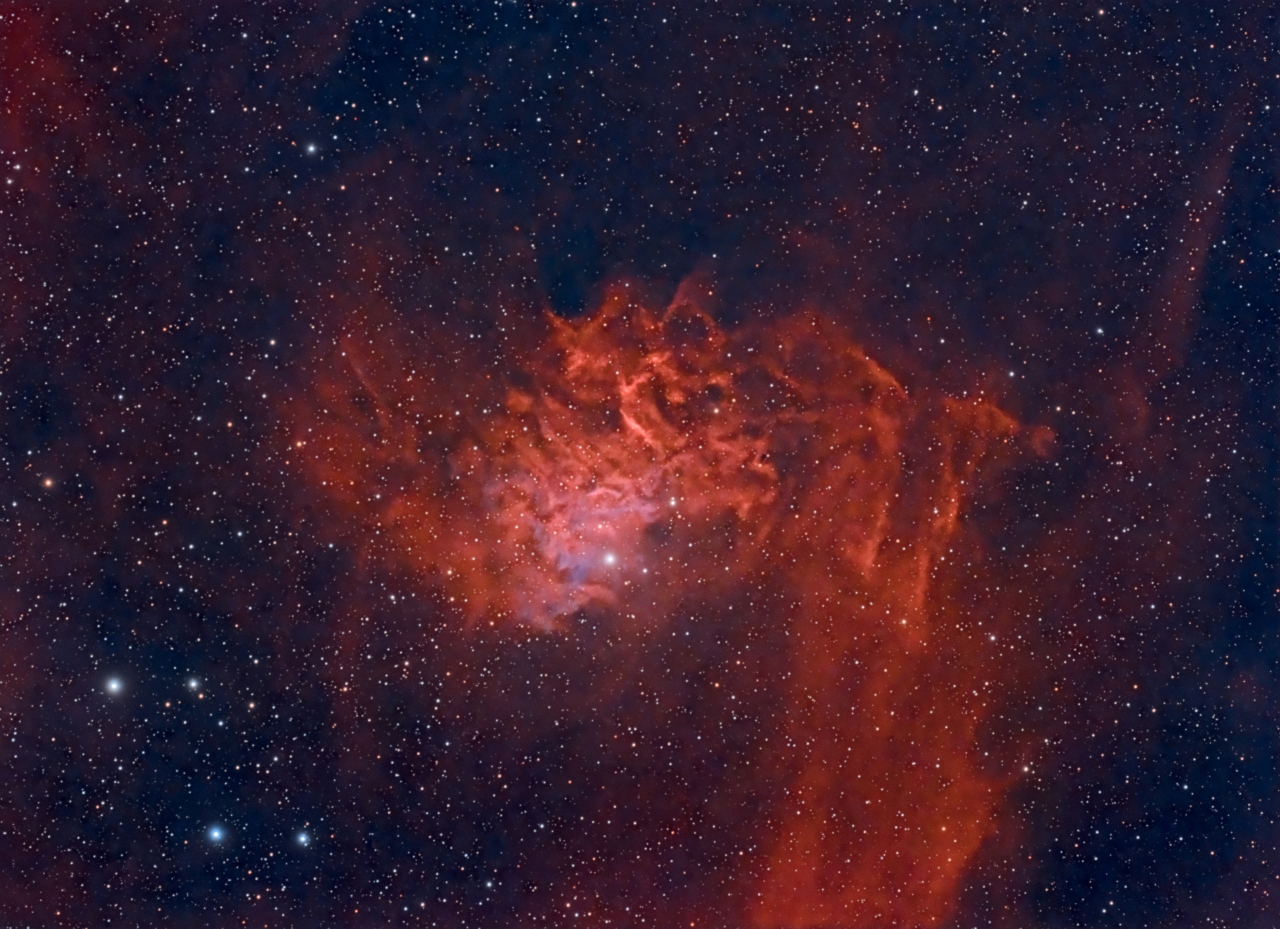
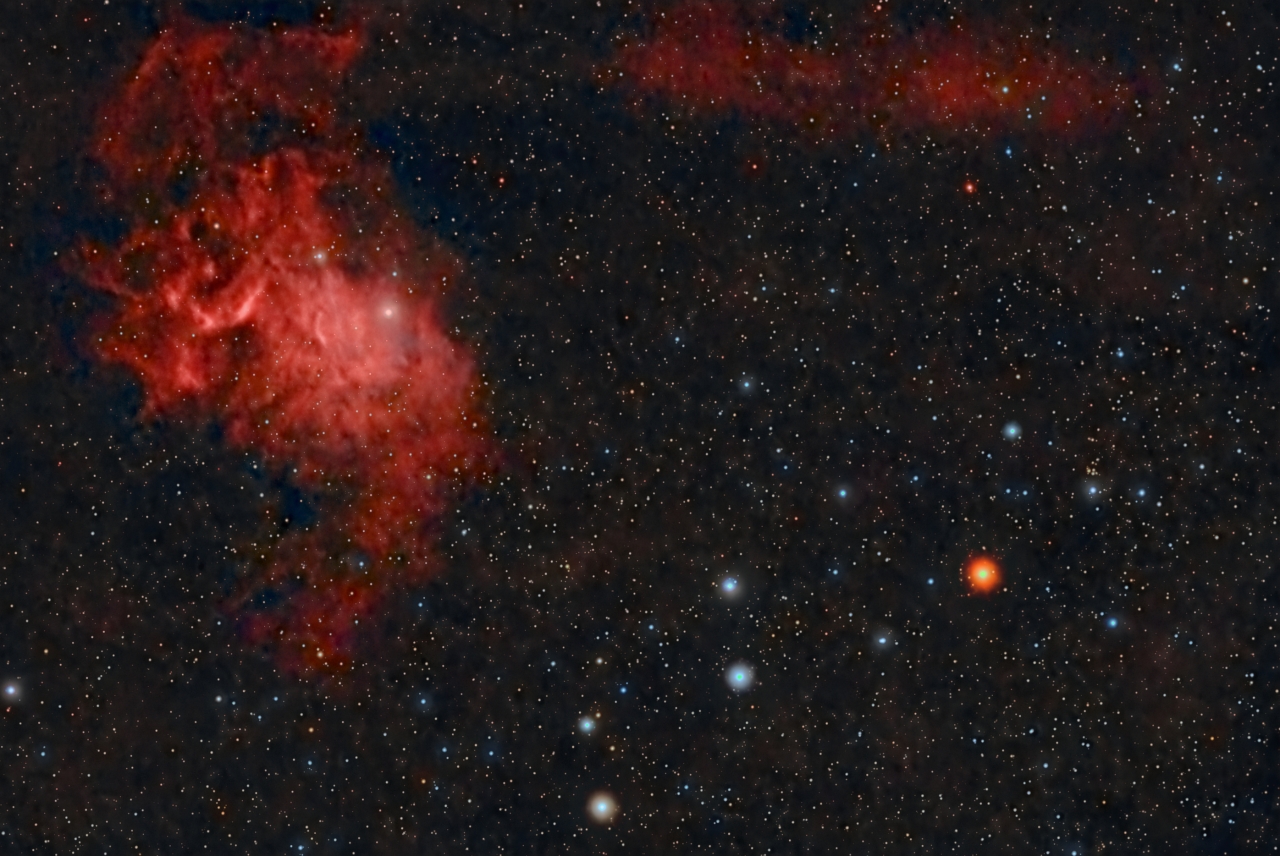
IC 405 and IC 410 form a physically related star-forming nebula complex in Auriga, seen in the same rich Milky Way field. IC 405 (the Flaming Star Nebula / Sh2-229 / Caldwell 31) is a mixed emission + reflection nebula whose glow and blue reflection haze are powered primarily by the embedded runaway star AE Aurigae (HD 34078). Modern distance estimates place IC 405 at roughly ~1,500 light-years (~460 pc), putting it in the foreground of the more distant Auriga star-forming regions. IC 405 was discovered photographically on 21 March 1892 by Johann Martin Schäberle (with later photographs the same year by Max Wolf and Eugen von Gothard), which is a nice historical reminder of how early astrophotography rapidly expanded the nebula catalog beyond what visual observers could reliably detect.
The defining “engine” of IC 405 is AE Aurigae, a hot O-type main-sequence star (spectral type ~O9.5 V) whose intense ultraviolet output ionizes nearby gas while its light also reflects from dust, producing the nebula’s characteristic two-component look in broadband and narrowband imaging. AE Aur is a well-studied runaway star, and its motion through the surrounding material is part of why the nebulosity shows sharp filaments and wind-sculpted structure. From an astrophysical standpoint, IC 405 is useful because it showcases, in one object, the interplay between UV photoionization (Hα emission) and dust scattering (blue reflection) in a real, complex environment—an observational “lab” for separating gas emission from dust-dominated features.
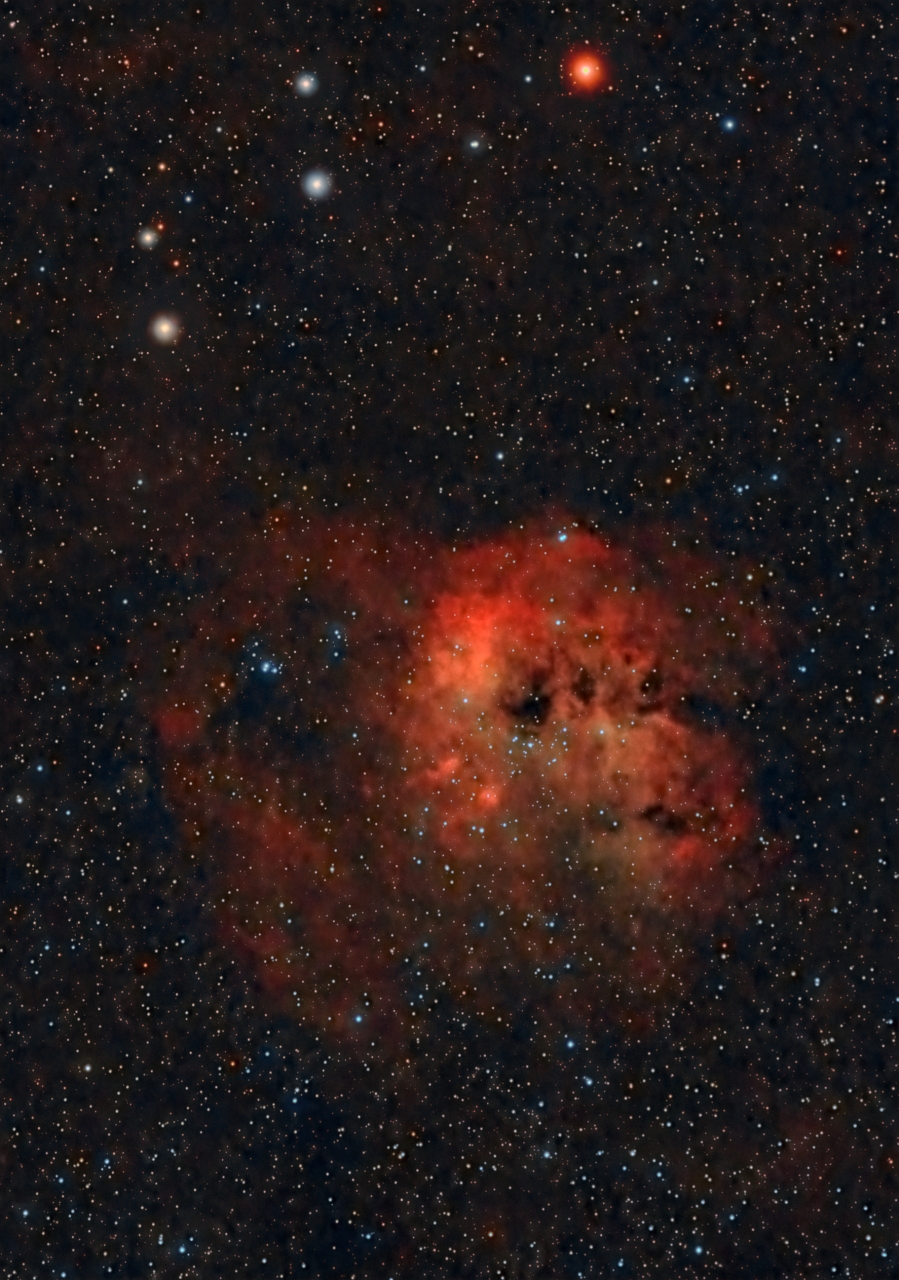
Just a few degrees away on the sky—but much farther in true distance—IC 410 (the Tadpoles Nebula) is an H II region surrounding the very young open cluster NGC 1893. IC 410/NGC 1893 lie at about ~12,000 light-years (~3.7–3.9 kpc) in the outer Milky Way direction, with the cluster age commonly cited near ~4 million years and a total young stellar population estimated at ~4,600 young stellar objects from X-ray/infrared studies. The nebula spans on the order of ~100 light-years, and its famous “tadpoles” (dark, cometary globules, often labeled Simeis 129 & 130) are dense knots of gas and dust being photoevaporated and shaped by stellar winds and radiation from the cluster’s massive, hot stars—direct, photogenic evidence of feedback processes that regulate star formation. The cluster itself was discovered by John Herschel on 22 January 1827, while the surrounding nebulosity IC 410 was identified later, photographically on 25 September 1892 by Max Wolf.
Sources & References
- Deep-Sky Corner — IC 405 history (Schäberle discovery date) + distance
https://www.deepskycorner.ch/obj/ic405.en.php - Deep-Sky Corner — IC 410 / NGC 1893 history (Herschel + Wolf)
https://www.deepskycorner.ch/obj/ic410.en.php - Steinicke Historic NGC/IC (biography note) — Schäberle and IC 405
https://www.klima-luft.de/steinicke/ngcic/persons/schaeberle.htm - Wikipedia — AE Aurigae spectral type (O9.5 V) and overview
https://en.wikipedia.org/wiki/AE_Aurigae - Wikipedia — NGC 1893 distance/age + ~4,600 YSOs (with literature pointers)
https://en.wikipedia.org/wiki/NGC_1893 - BBC Sky at Night Magazine — IC 410 distance and ~100 light-year scale
https://www.skyatnightmagazine.com/astrophotography/nebulae/tadpole-nebula-ic-410 - NASA APOD (2024-02-02) — IC 410 + NGC 1893 context and “tadpoles”
https://apod.nasa.gov/apod/ap240202.html - NED / Harold Corwin IC notes (archival catalog commentary) — IC 410 found by Max Wolf; NGC 1893 is the cluster
https://ned.ipac.caltech.edu/Library/Archive/HGCorwin/ngcic/icnotes.all
Project Details
-
Belleville, MI; Fall/Winter 25/26
-
ZWO FF65-FL=416mm, Pentax K3ii/ASI294MCPro, Antlia Triband RGBII filter, 4 minute subs, 8h43m Integration time