

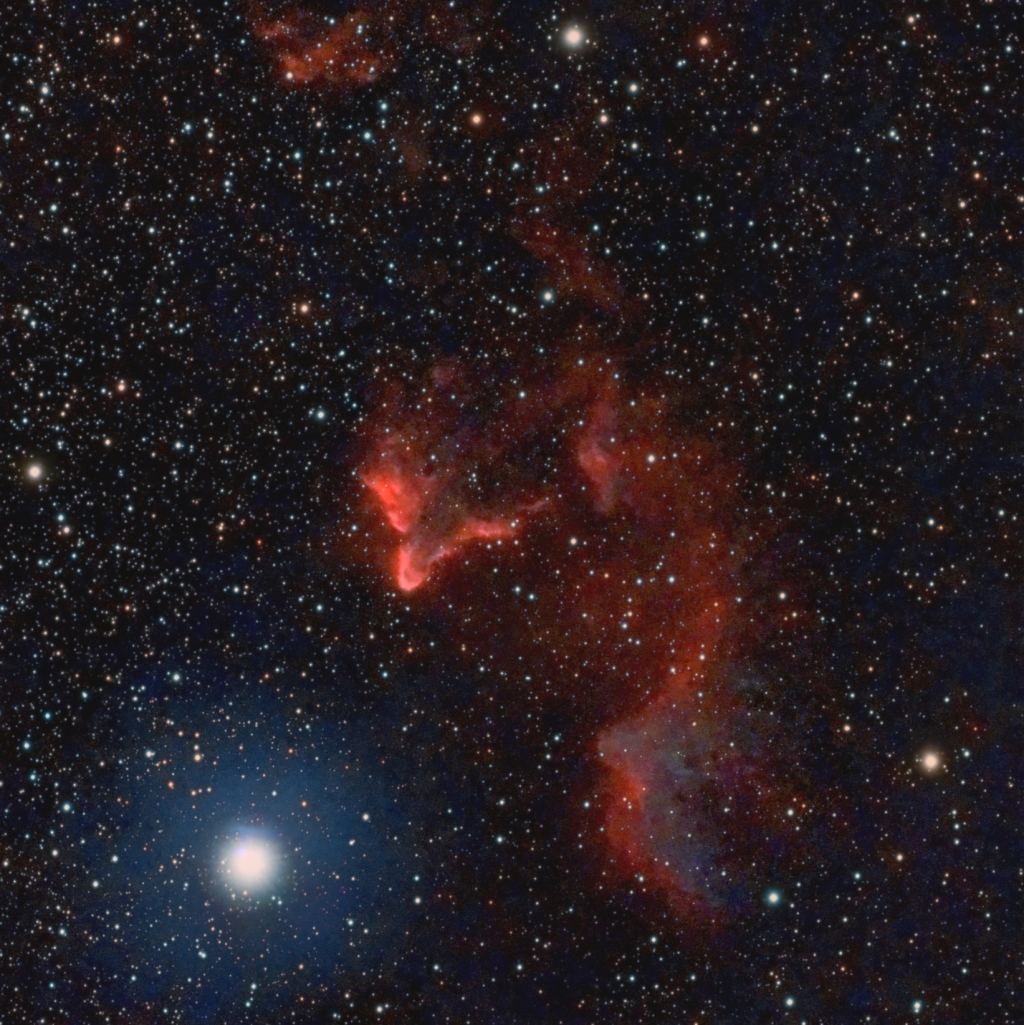
The Gamma Cassiopeia Nebula – IC59 – IC63
12/08/25, Belleville MI
IC 59, together with its nearby companion IC 63, forms the Gamma Cassiopeiae Nebula complex in the constellation Cassiopeia. These small nebulae lie immediately adjacent to the bright star γ Cassiopeiae (Navi) and are physically associated with it at a distance of roughly ~550–600 light-years. Both IC 59 and IC 63 are best described as reflection nebulae with weak emission components, representing illuminated surfaces of a nearby interstellar cloud rather than fully developed H II regions. Their proximity and geometry make the system an unusually clean example of stellar radiation interacting with the surrounding interstellar medium.
The dominant physical driver of the nebulae is γ Cassiopeiae, a massive B0.5 IVe star with a mass of approximately 15–17 solar masses, an effective temperature near 25,000 K, and a luminosity tens of thousands of times that of the Sun. Gamma Cassiopeiae is the prototype of the “Gamma Cassiopeiae variables,” a rare subclass of Be stars characterized by rapid rotation, strong hydrogen emission lines, a circumstellar decretion disk, and unusually intense and variable hard X-ray emission whose origin remains an active area of astrophysical research. Ultraviolet radiation from γ Cas illuminates nearby dust grains, producing the blue reflection glow seen in both IC 59 and IC 63, while partially ionizing the outer layers of the cloud and generating faint Hα emission. The differing orientations of the cloud surfaces relative to the star account for the contrasting morphologies of the two nebulae—IC 63 showing stronger ionization fronts, and IC 59 appearing softer and more diffuse.
The Gamma Cassiopeiae Nebulae were discovered photographically in 1893 by Max Wolf, during the pioneering years of astrophotography that revealed many faint nebulae invisible to visual observers. Scientifically, the IC 59 / IC 63 system has become an important nearby example of a photon-dominated region (PDR), where far-ultraviolet radiation shapes the chemistry, temperature, and structure of interstellar clouds without fully ionizing them. Because γ Cassiopeiae is bright, well-characterized, and close by, this nebular complex is frequently used to study stellar feedback, dust scattering, and the transition between reflection nebulae and emission nebulae, linking the physics of massive stars directly to their surrounding environments.
Sources & References
- SIMBAD Astronomical Database — IC 59
https://simbad.u-strasbg.fr/simbad/sim-id?Ident=IC+59 - SIMBAD Astronomical Database — IC 63
https://simbad.u-strasbg.fr/simbad/sim-id?Ident=IC+63 - SIMBAD Astronomical Database — Gamma Cassiopeiae (γ Cas)
https://simbad.u-strasbg.fr/simbad/sim-id?Ident=gamma+Cas - Wikipedia — IC 59 / IC 63 Gamma Cassiopeiae Nebulae
https://en.wikipedia.org/wiki/IC_59 - Wikipedia — Gamma Cassiopeiae (Be-star properties and X-ray behavior)
https://en.wikipedia.org/wiki/Gamma_Cassiopeiae - NASA APOD — IC 59 and IC 63 illuminated by Gamma Cas
https://apod.nasa.gov/apod/ap210207.html
Project Details
-
Belleville, MI
-
ZWO FF65-FL=416mm, ASI294MC Pro OSC, Antlia Triband RGBII, 4 min subs, 3h9m Integration time