

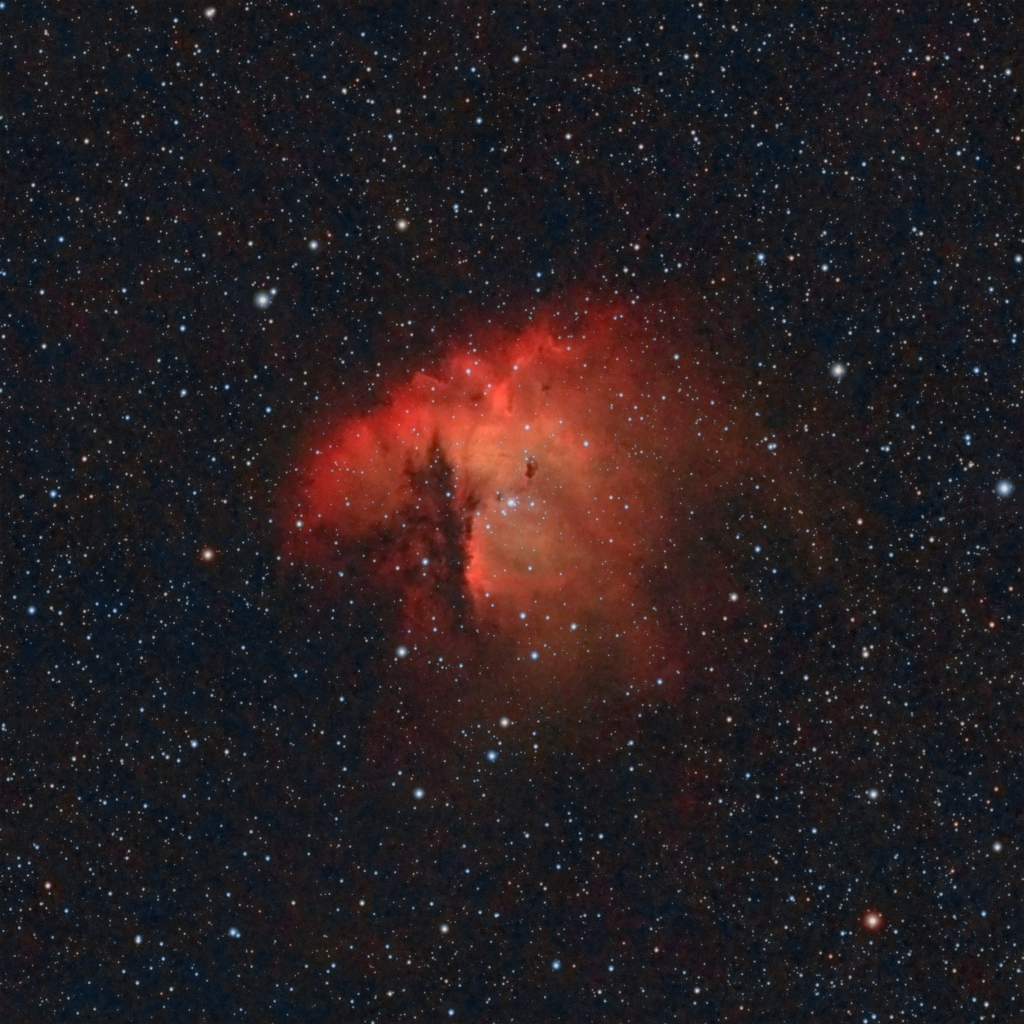
The PacMan Nebula – NGC 281
10/112/25 -10/15/25, Belleville MI
NGC 281, commonly known as the Pacman Nebula, is a prominent H II emission nebula located in the constellation Cassiopeia, projected along the Perseus Arm of the Milky Way. Distance estimates place NGC 281 at approximately 9,200–10,000 light-years (≈2.8–3.0 kpc) from Earth, making it a more distant and physically larger star-forming region than many nearby emission nebulae. The nebula spans roughly 35–40 light-years across and is associated with the young open cluster IC 1590, which is embedded near its center and provides the ultraviolet radiation required to ionize the surrounding hydrogen gas.
The dominant ionizing sources within IC 1590 are several hot O-type stars, including HD 5005, whose intense ultraviolet flux excites the nebula and drives ongoing feedback into the surrounding molecular cloud. Photometric and spectroscopic studies indicate an age of roughly ~3–5 million years for the cluster, consistent with the presence of massive, short-lived stars and ongoing star formation. The nebula contains numerous B-type stars, pre-main-sequence objects, and dense dust pillars, while infrared and X-ray surveys have identified hundreds of young stellar objects (YSOs) still embedded in the gas. The famous “mouth” of the Pacman is created by a large, obscuring dust lane cutting into the glowing hydrogen, sculpted by radiation pressure and stellar winds.
NGC 281 was discovered by Edward Emerson Barnard in 1883, during his systematic surveys of nebulae and dark lanes in the Milky Way. Scientifically, the Pacman Nebula has played an important role in understanding triggered star formation and superbubble dynamics. High-resolution studies have shown that parts of the nebula and its molecular clouds are moving away from the Galactic plane, suggesting they may have been lifted by past supernova explosions or large-scale feedback within the Perseus Arm. This combination of active massive star formation, embedded clusters, and large-scale kinematic motion makes NGC 281 a key object for studying how stellar feedback shapes star-forming regions in the Galactic disk.
Sources & References
- SIMBAD Astronomical Database — NGC 281
https://simbad.u-strasbg.fr/simbad/sim-id?Ident=NGC+281 - SEDS — NGC 281 / Pacman Nebula overview
https://spider.seds.org/spider/Misc/ngc281.html - Wikipedia — NGC 281 (distance, IC 1590, YSOs)
https://en.wikipedia.org/wiki/NGC_281 - NASA APOD — NGC 281 and IC 1590
https://apod.nasa.gov/apod/ap140127.html - Megeath et al., Triggered Star Formation in NGC 281 (ApJ)
https://iopscience.iop.org
Project Details
-
Belleville, MI
-
ZWO FF65-FL=416mm, Pentax K3ii, Antlia Triband RGB II, 4 min , 12h34m integration timesubs,