

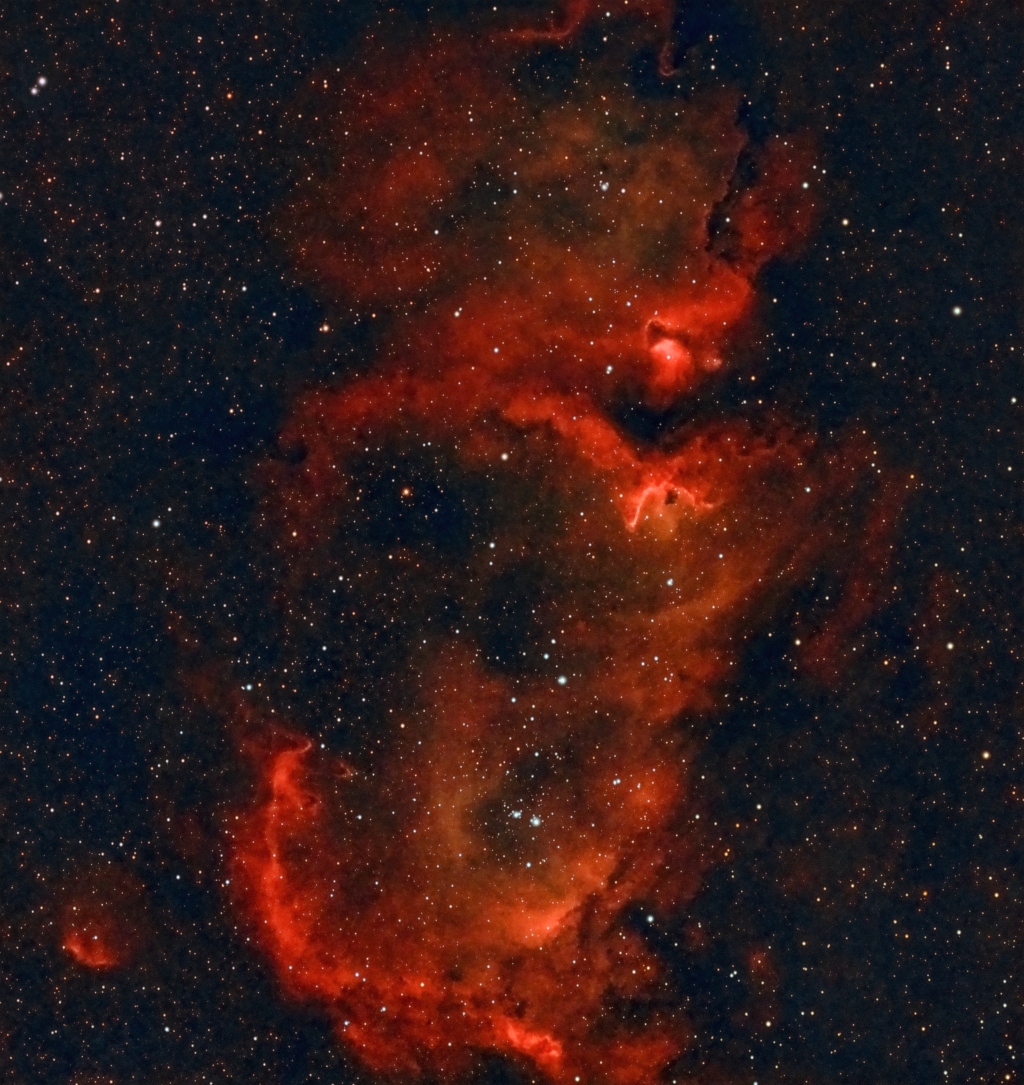
The soul nebula
12/4/25, Belleville MI
IC 1848, the Soul Nebula (also cataloged as Westerhout 5 / W5, Sh2-199, and LBN 667) is a large H II emission nebula in Cassiopeia on the northern Milky Way, widely paired with nearby IC 1805 (the Heart Nebula) as the “Heart and Soul” complex. It lies roughly 6,500–7,500 light-years away and spans on the order of 150 light-years across, making it a genuinely giant star-forming region rather than a small local nebula. IC 1848 is often used as the “name” of the whole object in astrophotography, but strictly speaking the IC designation refers to an embedded open cluster within the broader W5 complex.
The Soul Nebula’s light is dominated by recombination emission from ionized hydrogen (Hα) plus strong forbidden-line emission in places (notably [O III] and [S II] in shock- and ionization-front structures), produced where ultraviolet radiation from massive stars interacts with dense cloud surfaces. Several young clusters are embedded in the complex; one well-studied example is the IC 1848 cluster in W5 West, part of the larger Cas OB6 association, whose upper end includes O-type stars (e.g., studies cite stars such as HD 17505 and HD 17520) that carve cavities and bright rims in the gas. This makes W5 a classic site for studying feedback and “triggered” star formation, where expanding cavities and ionization fronts compress surrounding molecular material, potentially forming younger generations of stars along the edges.
Historically, IC 1848 is a good example of how photography expanded nebular discovery: it was discovered photographically by Edward Emerson Barnard, who reported it to Dreyer for inclusion in the Second Index Catalogue (published in 1910). Scientifically, the Soul Nebula complex is often used as a nearby(ish) template for understanding the multi-generation structure of giant H II regions—large cavities, bright-rimmed clouds, pillar-like dust structures, and embedded clusters—linking what you see in narrowband images directly to the life cycle of massive stars and their impact on the interstellar medium.
Sources & References
- DeepSkyCorner — IC 1848 history (Barnard discovery; IC entry context)
https://www.deepskycorner.ch/obj/ic1848.en.php - NASA/JPL (WISE image release) — Distance (~6,500 ly) and physical scale (~150+ ly)
https://www.jpl.nasa.gov/images/pia13014-soul-nebula/ - Wikipedia — Westerhout 5 / W5 overview; alternate designations; embedded clusters
https://en.wikipedia.org/wiki/Westerhout_5 - Lim et al. (2013), MNRAS — IC 1848 cluster in W5; Cas OB6 context; O-star content
https://academic.oup.com/mnras/article-pdf/438/2/1451/18753085/stt2283.pdf
Project Details
-
Belleville, MI
-
ZWO FF65, FL=416mm, f6.4, ASI294 MC Pro OSC, Antlia Triband RGB II, 4 min subs, 7h9m integration time