

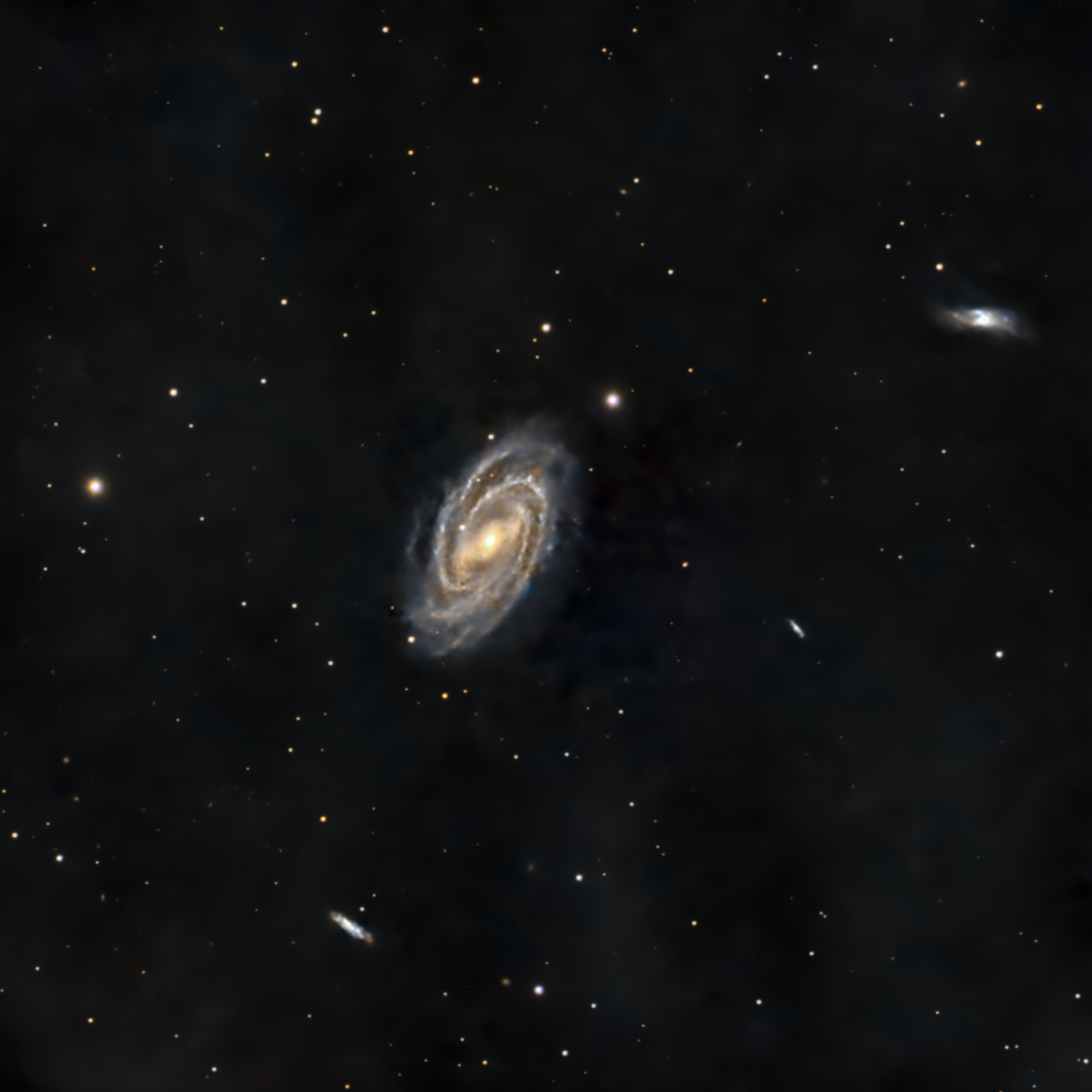
Messier 109
Messier 109 (M109) is a striking barred spiral galaxy located in the constellation Ursa Major, appearing just southeast of the bright star Phecda (Gamma Ursae Majoris), one of the bowl stars of the Big Dipper. At a distance of approximately 55–60 million light-years, M109 shines at an apparent magnitude of about 10.6, making it a rewarding target for medium to large amateur telescopes. Under good conditions, it appears as a soft oval glow, but longer exposures reveal its elegant barred structure and faint spiral arms.
Classified as an SBbc-type galaxy, M109 features a prominent central bar that channels gas inward toward the core, fueling ongoing star formation. From the ends of this bar, loosely wound spiral arms extend outward, dotted with star-forming regions and subtle dust lanes. The galaxy spans roughly 120,000 light-years across, comparable in size to our own Milky Way, and is oriented at a moderate angle, giving observers a partial view into its structure without being fully edge-on.
M109 is the brightest member of a small group of galaxies, often referred to as the M109 Group, which contains more than 50 known members. Several faint companion galaxies surround it, though most require deep imaging to detect. The galaxy’s proximity to Phecda makes it relatively easy to locate.
Sources
- NASA/IPAC Extragalactic Database (NED) – M109
- SIMBAD Astronomical Database – Messier 109
- de Vaucouleurs, G. et al. (1991). Third Reference Catalogue of Bright Galaxies (RC3)
- Kormendy, J. & Kennicutt, R. C. (2004). Secular Evolution and the Formation of Pseudobulges in Disk Galaxies. Annual Review of Astronomy and Astrophysics
Project Details
-
Belleville, MI Bortle 6+
-
ZWO FF107, FL=749mm, f7, ASI294MC Pro, Broadband, 4 min subframes, 3h56m integration